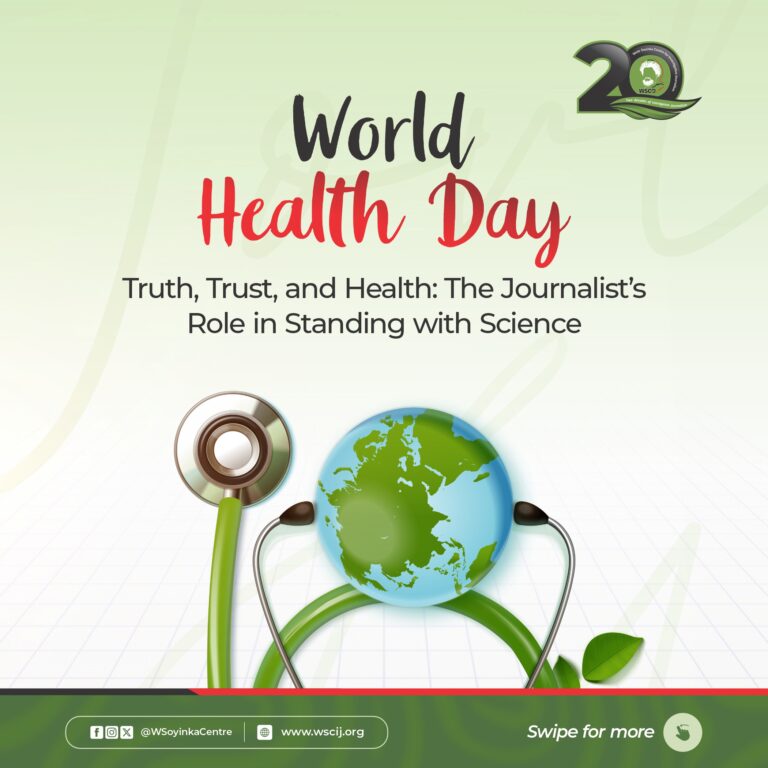
With this year’s World Health Day, marked annually on April 7, themed “Together for Health: Stand with Science,” the campaign underscores the critical role of evidence-based medicine, scientific collaboration, and the urgent need to combat health misinformation in an increasingly complex information ecosystem.
For journalists, this year’s theme is both a call to action and a reminder of responsibility. As frontline information gatekeepers, media professionals play a pivotal role in shaping public understanding of health issues, ranging from disease outbreaks and vaccination to environmental health and emerging scientific research.
In Nigeria and across the globe, the spread of misinformation particularly through digital and social media platforms continues to undermine public trust in science and health systems. This makes accurate, ethical, and evidence-based reporting not just important, but essential to safeguarding public health.
At a time when false cures, weak health systems, and inequities persist, journalism plays a critical role in bridging the gap between science and society. Investigative reports supported by the Wole Soyinka Centre for Investigative Journalism (WSCIJ), have continued to expose systemic failures, amplify underserved voices, and hold power accountable. Some of these include: Gravely ill patients die queuing to see Nigeria’s few specialist doctors, Where unhealthy cattle are slaughtered for public consumption, and Baba Aisha, Nigeria’s fake ‘doctor’ cashing out on deadly concoction that cures nothing
The “Together for Health” campaign also highlights the interconnectedness of human, animal, and environmental health, an approach widely recognised as “One Health.” For journalists, this presents an opportunity to deepen reporting beyond isolated health events and explore the broader systems that influence health outcomes.
Science has a history of both advancing knowledge and making serious mistakes due to limited evidence, bias, or ethical failures. Incidents like the thalidomide tragedy and the misleading promotion of OxyContin show how inadequate testing, unethical practices, and commercial influence can lead to harmful outcomes. Even in public health crises like COVID-19, changing guidance, such as on mask use, illustrates how scientific understanding can shift when evidence is still emerging.
Despite these shortcomings, science remains the most reliable method for understanding health and disease because it is inherently self-correcting. Knowledge evolves as new data becomes available, and changing recommendations reflect progress rather than weakness. For journalists, this highlights the need to report not just findings, but also their context, limitations, and uncertainties, helping the public to understand better how science works.
The Wole Soyinka Centre for Investigative Journalism (WSCIJ) calls on journalists to strengthen their capacity in health reporting by prioritising credible sources, verifying scientific claims, and translating complex data into accessible stories that inform and empower the public.
As the media landscape continues to evolve, standing with science means more than reporting facts; it requires a commitment to accuracy, accountability, and public interest journalism. On this World Health Day, journalists are encouraged to reaffirm their role as trusted voices in advancing health literacy and combating misinformation for the collective good.