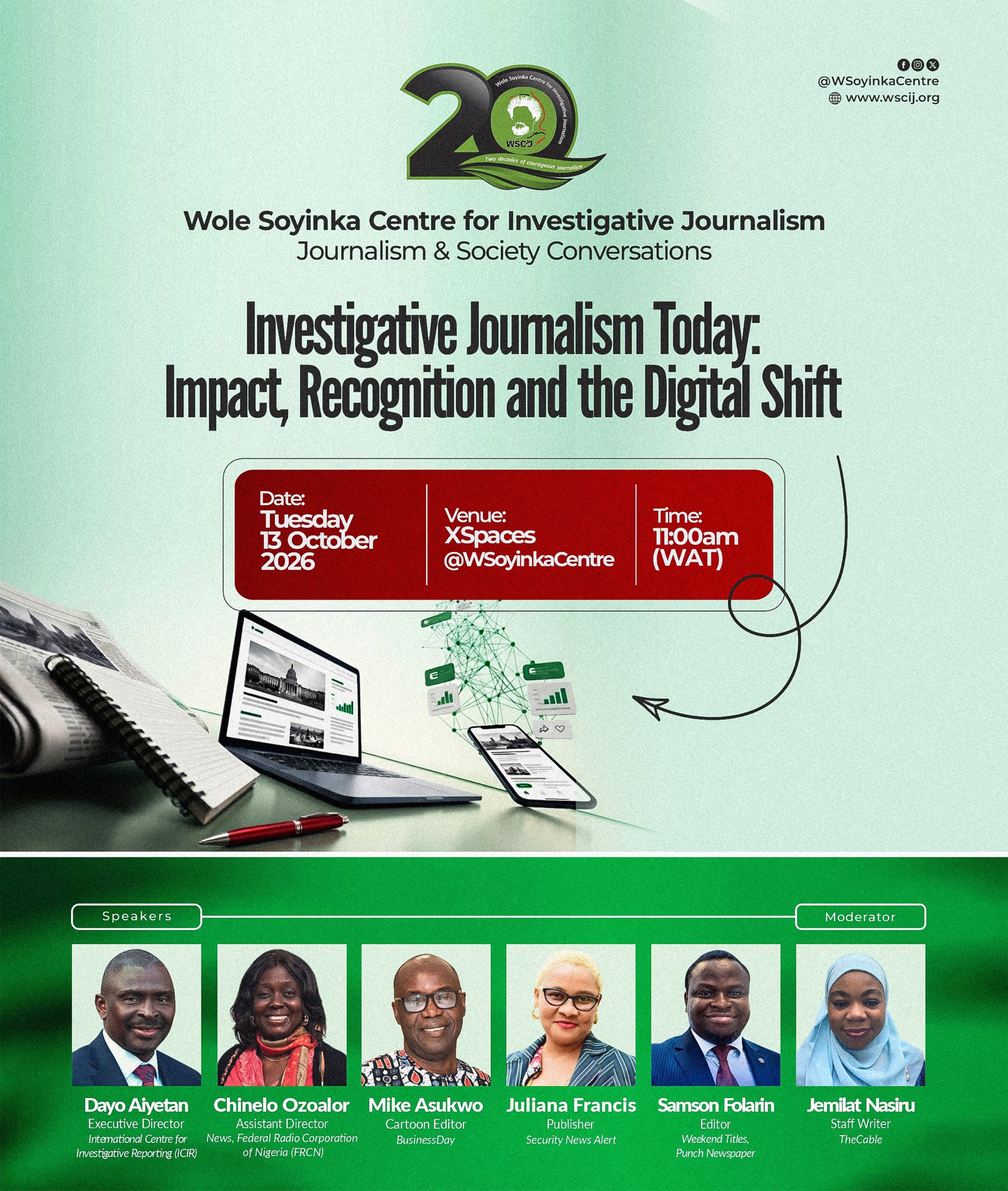
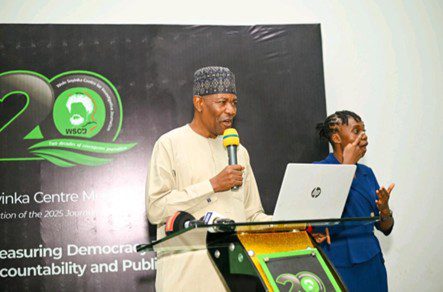
Presented at the 18th Annual Media Lecture Series of the Wole Soyinka Centre for Investigative Journalism (WSCIJ)
Your Excellencies, very senior officers of government here present, board members of the Wole Soyinka Centre for Investigative Journalism, distinguished ladies and gentlemen, good morning.
Let me start by thanking the Centre for finding me worthy of the invitation to deliver this year’s annual lecture. I have been fortunate to be part of the Centre from its inception to date. I know its history, and it has consistently been a story of progress, success, ruggedness, and an unyielding commitment to the Nigerian project. Therefore, what we are witnessing today is a continuation of our collective effort to improve the quality of journalism, which will ultimately strengthen democratic practice in this country. We know that things are not yet as they should be, and they can certainly be better. Nonetheless, the Centre has managed to remain afloat and continue to command the deep credibility of those we describe as our partners.
Let me also use this opportunity to congratulate the Grand Patron of the Centre, our icon, Professor Wole Soyinka, a man whose stories are always told, and whose immense contributions to strengthening democracy in this country are beyond doubt. He has always been a moral force and a voice to reckon with. We pray that he continues to live a very fruitful, healthy life, and continues to contribute to humanity.
Alongside him, let me also congratulate another tireless fighter for truth, Lanre Arogunbade, who has been an integral part of this Centre and is fortunate to share a birthday with Professor Wole Soyinka.
Democracy as Procedure vs. Democracy as Substance
We are here today to speak on the theme “Beyond the Ballot.” As we prepare for future elections, it is critical that we reflect on our journey so far. We have engaged in periodic elections; leaders have been voted in, and more will still be voted into office. But we must ask: what do Nigerians actually expect from this democracy?
While democracy is a universal concept, every nation brings its own unique context to its interpretation and practice. Fundamentally, democracy can be categorized into two dimensions: procedural democracy and substantive democracy.
Procedural democracy emphasizes the mechanics: elections, political parties, a constitutional order, the separation of powers, and the structural basics that give a democratic system its form.
Substantive democracy, on the other hand, is about what people experience in their daily lives. It is measured by concrete realities: human security, economic welfare, social justice, accountability, and public trust. Without these, democracy remains an abstract concept. Only when these substantive issues are addressed does democracy take on real meaning for the citizens.
This leads us to a fundamental question: Can a nation be considered truly democratic simply because it conducts periodic elections?
Today, across different parts of Africa, there is growing worry over democratic backsliding. Recent Afrobarometer surveys across 39 African nations reveal that while two-thirds of Africans prefer democracy to any other form of government, only 37% are satisfied with the way democracy actually works in their countries. Furthermore, the 2024 African Youth Survey—which polled 5,600 young people, including Nigerians—revealed that 60% want to emigrate due to systemic corruption threatening their future. Shockingly, 1 in 3 respondents believe that democratic rule has no future for them.
Understanding the Context: The Substantive Deficit
To understand Nigeria’s current situation, we must look beyond immediate security concerns and address the deeper, structural roots of our instability:
- Historical grievances and identity politics.
- Deep social and economic exclusion.
- Youth unemployment and widespread frustration.
- Weak public institutions and severe governance deficits.
- The rise of misinformation, hate speech, and deeply divisive narratives.
You cannot discuss true democracy without addressing economic reality. Issues of inequity, lack of opportunity, and survival affect us locally, nationally, and individually.
The Cost of Economic Deprivation
Consider the security crises across this country. What drives people to criminality? We cannot detach these outbreaks from the demographic pressures, institutional deficiencies, and deep deprivations caused by extreme poverty. When economic issues and public frustration are left unaddressed, the consequences are catastrophic.
According to conservative estimates from organizations like UNICEF and the National Bureau of Statistics, approximately 18.3 million young Nigerians are currently out of school. This is a ticking time bomb. In a national ecosystem, a crisis in one sector inevitably triggers a collapse in others.
I remember when the Boko Haram insurgency first began in Maiduguri; many people in other parts of the country assumed it was a localized affair that would not affect them. But we quickly learned otherwise. Consider a simple example: the vast amount of fish that used to flow to Lagos from the Lake Chad basin ceased. Naturally, this disruption affected the supply and drove up the price of fish nationwide.
Years ago, I led a research team commissioned to study the Lake Chad region. What I witnessed there was a stark demonstration of governance deficits. In those communities, there was immense economic activity—massive trade in fish, cattle, wheat, and rice. People had money, but there was absolutely no government visibility except for tax collectors. There were no schools, no healthcare facilities, no infrastructure, and no law enforcement. You had a population with economic resources but no leadership to give structure or direction to their lives.
We abandoned that vital region. Historically, the Shagari administration constructed a massive power generation plant in that area, designed to supply the entire Northeast and power vast irrigation and agricultural projects. I do not believe those plants have functioned since the Shagari era, and only God knows what state they are in today.
Institutional Decay: The Local Government Collapse
Another glaring symptom of our governance deficit is the near-total collapse of the local government system.
Historically, especially in northern Nigeria, local governments provided the vital first line of governance. They solved immediate community issues, resolved farmer-herder conflicts locally without escalating them, awarded petty contracts to keep local youth occupied, and managed primary education and healthcare.
Today, that entire system has collapsed. While the current federal administration has made efforts to grant financial autonomy and ensure that subventions go directly to local governments, the success of these measures remains a major question mark for all of us to ponder.
The Information Crisis: Misinformation and Polarisation
Within this fragile environment, we now face a dangerous accelerant: misinformation, hate speech, and divisive narratives.
As a multicultural and diverse nation, Nigeria has always had fault lines, but we have historically managed them. However, the internet and the digital communication revolution—while bringing remarkable progress to our daily lives—have also introduced severe negative consequences that we are weaponizing against ourselves.
In our current democratic landscape, the problem is no longer the absence of information, but rather an overwhelming abundance of inaccurate information, coupled with a severe scarcity of public attention. We are increasingly using these digital tools to manufacture division rather than solve our collective problems.
Applying the Human Security Framework
How does the Human Security Framework (as championed by the UNDP since 1994) apply to our current reality? True human security goes beyond military defense; it encompasses freedom from want and freedom from fear.
- Hunger and Poverty
Wherever there is active conflict, hunger inevitably follows. Farmers cannot access their lands, business activity grinds to a halt, and capital flees. Money is a timid commodity; it never goes where its safety is threatened. Nobody is taking their investments into the Sambisa Forest, nor are they eager to relocate their resources to high-risk states.
This breeds a vicious cycle: conflict causes hunger, and hunger fuels further conflict. Today, Nigeria’s poverty index stands at a staggering 41.8%—meaning nearly half of our population lives below the poverty threshold. Extreme poverty drives individuals to desperate measures. A person stripped of economic dignity will seek survival anywhere, even if it means turning to crime.
It is no secret that many of the violent conflicts in the North are directly tied to illegal mining and fierce competition over farming land—crises that are heavily compounded by climate change and our collective failure to manage resources sustainably.
- Public Health, Education, and Digital Threats
Poverty, disease, unemployment, environmental disasters, and digital threats all degrade the quality of human security. In a highly diverse and pluralistic nation like ours, these challenges test our ability to manage our differences. When we fail to manage this diversity due to historical grievances and poor identity management, we end up exactly where we are today.
The Crisis of Security and Leadership
Today, just as in 2015, security remains the single highest expectation that citizens have of government at all levels—local, state, and federal. Yet, since our return to democratic rule in 1999, our security agencies have been locked in a continuous battle against insurgency, banditry, kidnapping, farmer-herder clashes, communal violence, separatist agitations, and rising urban criminality.
Sometimes, reading our morning papers or scrolling through social media makes you feel too unsafe to step out of your house or travel by road. Personally, I still travel. Just two weeks ago, I drove from Maiduguri to Kano, and I regularly drive to various parts of the country. Out of the 36 states in Nigeria, there is only one state I have not driven my own car to: Bayelsa. I have driven through every other state because of my fundamental belief that we must have confidence in our nation.
But we must look at the structural reality. Nigeria spans over 923,000 square kilometers. We cannot realistically place a police officer on every single corner. Safety, therefore, requires public trust, institutional authority, and the visible presence of credible leadership. The quality of leadership at every level directly dictates the quality of life the rest of us experience.
The Human Cost of Delayed Education
Our security failures have exacted an enormous human toll. In parts of Borno, Zamfara, and other troubled states, there are communities where children have not stepped inside a classroom for the last 10, 15, or even 20 years due to persistent insecurity.
These are young Nigerians growing up completely stripped of life’s vital milestones:
They are growing up by the millions in the shadows. What happens when this generation reaches adulthood, looks at the opportunities enjoyed by other Nigerians, and realizes they have no representation, no skills, and no stake in the Nigerian system? We must answer these questions. We cannot continue to pretend these millions of young citizens do not exist when they are right there on our map. If we do not address the aftermath of these human crises, our democracy will remain permanently crippled.
Welfare: The True Dividend of Democracy
Citizens do not evaluate democracy by reading constitutional provisions; they evaluate it through their lived experiences. The ordinary citizen asks simple, fundamental questions:
- Can I find employment in this democratic system?
- Can I feed my family?
- Can I access basic healthcare?
- Can my children receive a quality education without me having to pay fees I do not have?
- Can I live my life with basic human dignity?
Look at the empirical data:
- Life Expectancy: The average life expectancy of a typical Nigerian is just 55 years—a figure reflecting the high risk of infant mortality, road accidents, disease, violence, and hunger.
- Electricity Access: Only 61.2% of our population has access to electricity.
- Poverty: 41.8% of our people live below the poverty line.
If our democracy cannot answer these basic questions today and tomorrow, then we are facing an existential crisis. Democracy must yield developmental dividends. It must reduce poverty. We elect leaders to think strategically on our behalf, not to watch them grow wealthier while the general population plunges deeper into poverty. We cannot run a system where a few individuals’ stomachs get larger and larger while the rest of the nation suffers from economic diarrhea and constipation. It is unsustainable.
Rebuilding the Economy, Education, and Accountability
We must guarantee security because without it, there is no physical space for democratic processes or economic productivity. Beyond security, we must revitalize our productive sectors to create genuine jobs outside of government.
- Resource Management
Our industries must be rebuilt, particularly the mining sector, which is currently being plundered illegally. We know, for instance, that some of the largest deposits of gold are located in Zamfara and Sokoto. Sokoto also holds confirmed petroleum deposits—Mobil Nigeria documented this years ago. Why are we not legalizing, regulating, and securing these extractions? Instead, we allow foreign actors and local cartels to exploit these resources through crude, unregulated methods that destroy local communities and leave our land in ruins.
- Educational Standards
The quality of our education determines the quality of our human capital. Expanding the educational system without enforcing strict quality control is a dangerous deception. We are opening schools and universities left and right without paying attention to the standards of instruction, infrastructure, or character training required to raise the actual builders of this nation.
With a population exceeding 230 million living on the same fixed landmass, the competition for dwindling opportunities is fierce. We must put on our thinking caps to manage this demographic reality.
- Confronting Corruption
We must confront systemic corruption. With the various anti-graft agencies we have, we frequently read of sums stolen or misappropriated with so many zeros that the average citizen cannot even comprehend the figure. It makes one wonder: what does one human being need all these stolen public resources for?
We must interrogate our national values. A democracy that fails to improve livelihoods eventually loses its moral legitimacy.
I was once asked by a student in my class: “Sir, why are you punishing us for examination malpractice? People steal billions of Naira, they go to court, secure permanent injunctions, and walk free. Why dismiss me for copying an answer while they walk free after stealing our collective future?”
I told him that while I could not justify the systemic double standards, the academic rules must still be enforced. But it is a haunting question. If your child asks you that, what will you say? Stealing is stealing, whether intellectual or financial. But when a system allows massive public theft to go unpunished, it subverts its own legitimacy. Citizens lose the incentive to participate honestly, and political apathy, disinformation, and social fragmentation take over.
Reclaiming Public Trust
At its core, democracy requires accountability. This means public officials must explain their actions, oversight institutions must function effectively, and leaders must face sanctions for misconduct. Without accountability, public resources are wasted, corruption runs rampant, and public trust completely erodes.
Trust is the invisible foundation that holds a heterogeneous, multicultural nation like Nigeria together. Democracy thrives only when citizens have basic trust in the government, the electoral system, the security agencies, the judiciary, and the media.
Today, we face a deep crisis of trust. The northern man suspicions the southern man, the student distrusts the teacher, and the citizen distrusts the state. This foundation of trust can only be restored when citizens see leaders who are truthful, ethical, and demonstrably competent in managing public resources for the common good.
Conclusion and Recommendations
Nation-building is a continuous, generational project. We cannot solve our security challenges or eradicate corruption overnight. It requires structural changes and a massive shift in our cultural values.
When you see the level of systemic compromise in our educational and public systems, you have to ask: are these the individuals who will eventually occupy our National Assembly and lead our ministries?
During my school days in 1981, writing the GCE, cheating was unthinkable. Today, we hear of parents paying for “expo” or “assistance” to help their children pass WAEC. What is the difference between academic cheating at the grassroots and the financial looting we see in high offices? They spring from the same moral decay.
To navigate out of this conundrum, we need:
- Elite Consensus: Our political, economic, and traditional elites must agree on core, non-negotiable national priorities. If the leadership class establishes a unified, patriotic direction, the nation will follow.
- Credible Leadership Recruitment: We must establish robust systems to ensure that only competent, ethical, and public-spirited individuals emerge through the ballot box.
- Support for Critical Institutions: We must commend and protect institutions like the Wole Soyinka Centre for Investigative Journalism for undertaking the highly risky, necessary work of investigative journalism to keep power in check.
We need focused leadership. The ballot must give us the legitimacy to trust that those who govern do so by our genuine consent, as that consent is the vehicle that will ultimately carry Nigeria to its promised land.
Once again, let me congratulate our esteemed Grand Patron, Professor Wole Soyinka, on his 92nd birthday. It is an extraordinary milestone, and we pray that God grants you many more healthy years. My deep thanks go to the Wole Soyinka Centre for Investigative Journalism for inviting me to share these thoughts with my thoughts with a quality audience like you.
Thank you all for your kind attention.