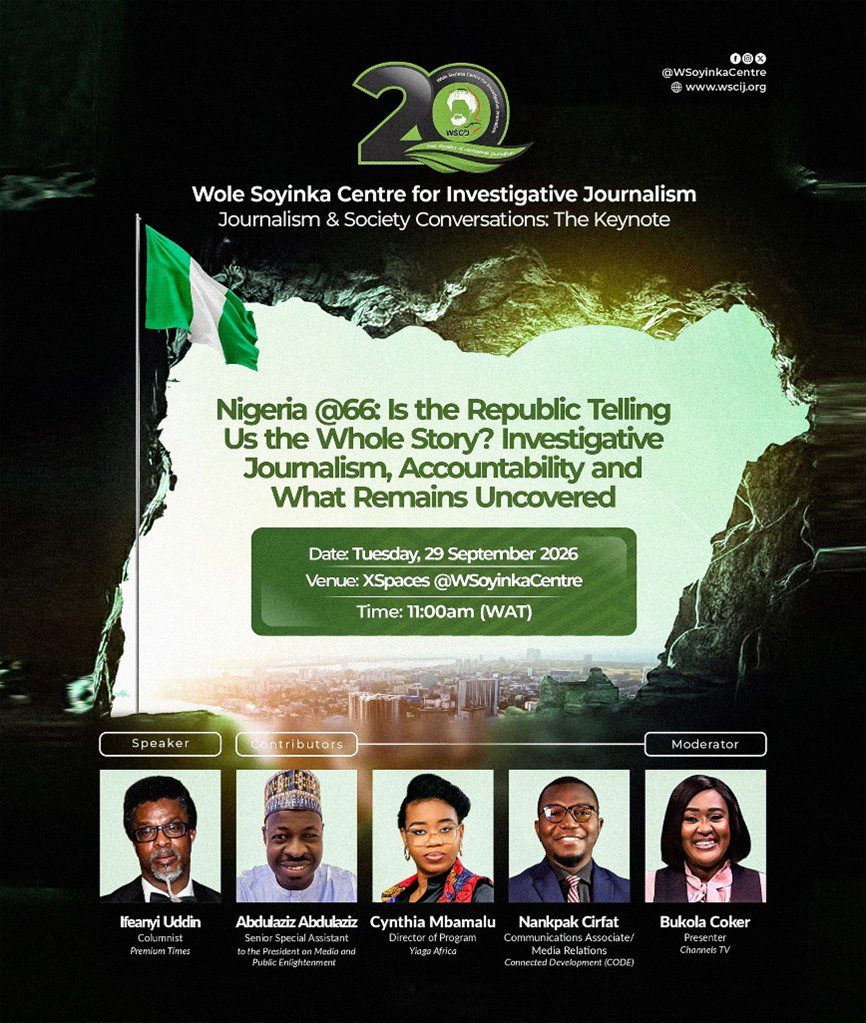

As Nigeria prepares to mark another year of its independence, questions about the stories the country tells about itself, the evidence behind those narratives and the realities that remain outside public view took centre stage at the September edition of the Wole Soyinka Centre for Investigative Journalism’s (WSCIJ) Journalism & Society Conversations on Tuesday, 29 September 2026.
The special edition, “The Keynote”, themed “Nigeria @66: Is the Republic Telling Us the Whole Story? Investigative Journalism, Accountability and What Remains Uncovered,” examined what investigative journalism has helped Nigerians know about governance, public resources and institutional performance, while asking what stories still require deeper scrutiny as the country approaches the 2027 general elections.
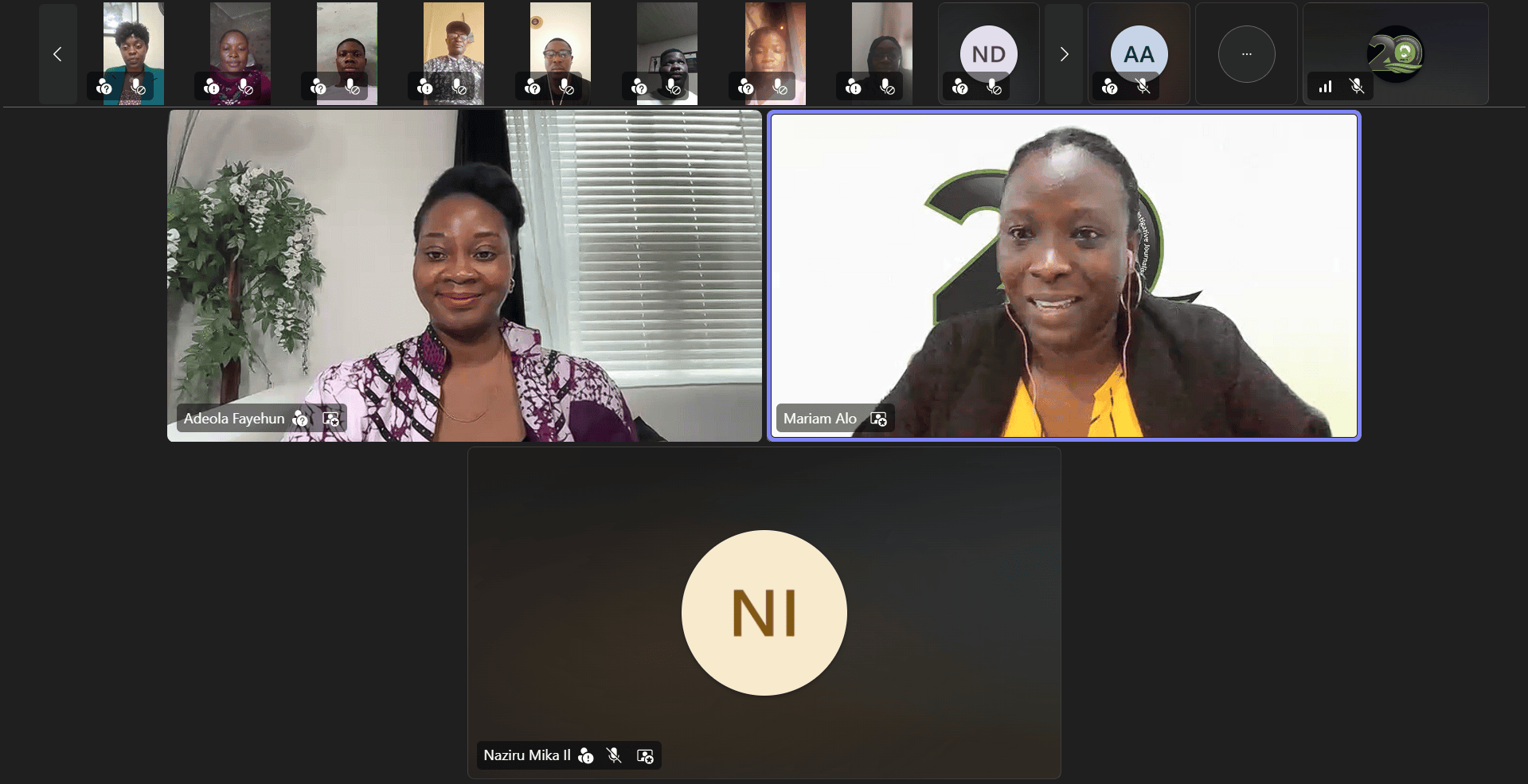
Moderated by Bukola Coker, broadcast journalist and presenter at Channels Television, the conversation featured Ifeanyi Uddin, columnist with Premium Times, as keynote speaker, with Abdulaziz Abdulaziz, Senior Special Assistant to the President on Media and Public Enlightenment; Cynthia Mbamalu, Director of Program, Yiaga Africa; and Nankpak Cirfat, Communications Associate – Media Relations, Connected Development (CODE) as contributors.
In her opening remarks, Motunrayo Alaka, Executive Director/CEO, who was represented by Osita Nwajah, Senior Adviser, Strategy, Knowledge & Programme Quality, WSCIJ, situated the conversation within a broader pattern explored by recent editions of the Journalism & Society Conversations. He noted that discussions around civic space, school safety, and now Nigeria’s national story all raise questions about the distance between institutional commitments and citizens lived realities. He argued that this gap should shape the questions investigative journalists ask. Rather than limiting investigations to individual scandals, he urged journalists to examine the systems, interests and consequences behind public decisions.
Building on this, Ifeanyi Uddin argued that investigative journalism must look beyond individual scandals to examine the systems that produce them. He identified financial, administrative and social accountability as interconnected dimensions of public accountability, asking whether government spending corresponds with citizens’ priorities and, ultimately, who bears the cost when institutions fail?
For Uddin, this means asking fundamental questions about ownership, beneficiaries, decisionmakers and consequences: Who owns what? Who benefits? Who determines? What happens afterwards? And who ultimately pays the price? Referencing investigations by a consortium of national and international news media, including Premium Times, such as the Panama Papers and Pandora Papers, he argued that consequential journalism requires journalists to trace relationships, interests and outcomes rather than stopping at the initial revelation.
Abdulaziz Abdulaziz similarly called for a wider lens, particularly in examining accountability beyond the federal government. He observed that the Nigerian media often concentrates its scrutiny on the centre while overlooking the subnational levels, despite the quantum of resources and decisions managed there.
He urged journalists to approach investigations with greater openness and to expand the range of issues they cover, including the private sector and industries such as mining. He also cautioned that responsible journalism requires journalists to balance scrutiny with an understanding of the wider public interest.
The imperative to connect public spending to citizens’ actual needs was further emphasised by Nankpak Cirfat, who identified the gap between community priorities, government policy and funding as an important area for investigative journalism.
Cirfat explained that projects should first be assessed against the needs of the communities they are intended to serve, rather than simply being evaluated by whether government commitments were formally met. He pointed to gaps in implementation, supervision and citizen feedback as areas journalists can investigate, arguing that public projects should be examined not only for what was promised or spent, but for whether they produced the intended benefits.
The conversation also turned to the relationship between investigative journalism, the rule of law and citizen participation. Cynthia Mbamalu challenged journalists to ask what questions they are failing to ask and what evidence they are yet to demand. She called for greater attention to institutions that receive limited scrutiny, particularly the judiciary, which she linked to the broader questions of rule of law, economic development and accountability.
Mbamalu also stressed the need to strengthen information integrity and develop storytelling approaches that respond to Nigeria’s growing youth population. She called for greater investment and partnerships to support investigative journalism, alongside the use of technology to make credible information more accessible to citizens.
The discussion extended beyond the panel, with participants reflecting on the responsibility of journalism to connect public policy with citizens’ everyday realities. Wale Adegbite urged journalists to consider the quality of lives people are able to lead, particularly through access to infrastructure and economic opportunities, while Usman Shehu, drawing from his experience in government communications, noted that citizens want more than information about policies; they want to understand how those policies affect their daily lives.
The conversation also provided an opportunity to announce the opening of the 21st Wole Soyinka Award for Investigative Reporting (WSAIR) call for entries on 4 October 2026. The award invites professional Nigerian journalists and teams to submit public-interest investigations published within the eligibility period, further reinforcing the need for journalism that uncovers corruption, human rights violations and regulatory failures.