

The Wole Soyinka Centre for Investigative Journalism (WSCIJ) has urged journalists to move beyond simply publishing investigative stories and adopt deliberate digital and storytelling strategies to expand their reach, engage audiences and maximise impact.
The call was made during a training organised by the Centre under the Collaborative Media Engagement for Development, Inclusivity and Accountability (CMEDIA) Project themed “Maximising Digital Platforms: Amplifying Investigative Stories, Engaging Audiences and Unlocking Opportunities.”
The training featured Naziru Abubakar, Digital Journalism Trainer and former Editor-in-Chief of Daily Trust Newspaper, whose session was titled “From Story to Strategy: Optimising Investigative Journalism Across Digital Platforms,” and Adeola Fayehun, producer and host of Keeping It Real With Adeola, who addressed “Beyond Publishing: Creator-Led Journalism and the Art of Engaging Audiences with Investigative Stories.”
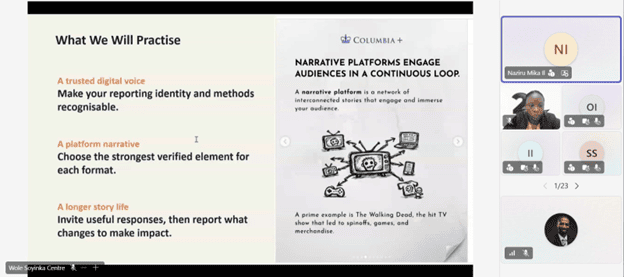
Building a narrative around every investigation, Abubakar said journalists should treat publication as the beginning, rather than the end, of an investigative story journey. He encouraged journalists to build a deliberate “narrative platform” around their investigations, using multiple formats and digital platforms to create different entry points into the same story.
“You need to find a way to build a narrative platform that would bring all your audiences together and discuss as many things as possible in a connected manner, in a continuous loop,” he said. According to him, a single investigation could be developed into the main story, short videos, evidence-based carousels, audio-visual content, live discussions, and shareable versions for messaging platforms.
Abubakar noted that platforms such as TikTok, Facebook, Instagram, X, WhatsApp, and Telegram have different characteristics, requiring journalists to adapt their storytelling to how audiences consume content on each platform. The former Daily Trust Editor-in-Chief also stressed the importance of verification, transparency, and accountability in digital journalism. He urged journalists to clearly demonstrate how evidence was gathered and verified, give subjects the right to reply, publish corrections when necessary, and protect sources from exposure.
Abubakar further urged journalists to measure the impact of investigations beyond views, likes and shares by monitoring new evidence, audience responses, policy actions, new sources and opportunities for follow-up reporting.
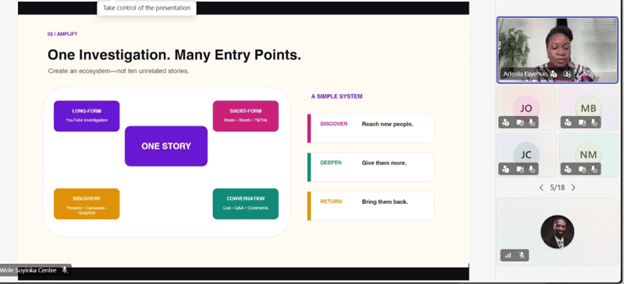
Fayehun, on her part, reinforced the need for journalists to think beyond the traditional publication model, describing an investigation as a “content ecosystem” capable of generating multiple forms of content and audience engagement.
“One investigation should actually become a content ecosystem,” she said, encouraging journalists to develop long-form stories alongside short videos, quote graphics, behind-the-scenes content, live discussions and follow-up engagements.
She said journalists must go where their audiences are instead of expecting people to find their stories on a single platform. “It is now our job to go to where people are, not just publish your story and expect that everybody will find it where you put it,” Fayehun added.
She also encouraged journalists to simplify complex investigations without compromising accuracy, using conversational language and platform-appropriate formats to sustain audience attention.
Fayehun illustrated the potential of this approach with an investigative story that received about 127,000 views on YouTube but recorded approximately 291,000 views on TikTok, 859,000 on Facebook and more than 1.1 million on Instagram after being adapted for each platform. The story recorded a combined 2.3 million views across the four platforms, she said.“Don’t count out any platform because you just never know where your story will do well,” she said. Fayehun also urged journalists to build their personal brands alongside the platforms of the organisations they work for, while maintaining strong standards of verification, attribution and accuracy.
“As you are developing someone else’s brand, develop your own brand as well,” she said, noting that audience trust can help journalists build credibility, access new sources and generate professional opportunities.
The training underscored the need for investigative journalists to see publication as the beginning of a broader process of distribution, audience engagement and sustained impact, supported by strategic digital storytelling, verification and trust.