
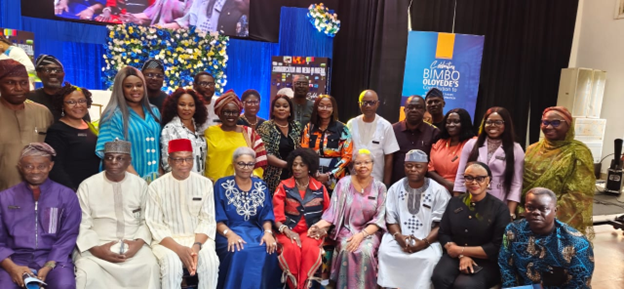
The Wole Soyinka Centre for Investigative Journalism (WSCIJ) joined media leaders, policymakers, scholars and creative industry practitioners to celebrate veteran broadcaster and WSCIJ Lifetime Award for Journalistic Excellence winner, Bimbo Oloyede, as she marked five decades of contributions to broadcasting and also launch her festschrift .
The publication titled “Communication and Media in Nigeria,” was unveiled at a public presentation held in Lagos on Tuesday, 1 September 2026 to commemorate Oloyede’s 50 years of professional practice and contributions to the development of Nigeria’s media and communication industry.
Speaking at the event, WSCIJ Executive Director/CEO, Motunrayo Alaka, commended Oloyede for sustaining a remarkable 50-year legacy in Nigeria’s media landscape and for continuously reinventing herself throughout her career.
Alaka described Oloyede as a “dreamer” who has remained consistent in seeking new opportunities to contribute to society and redefine her role within the media space.
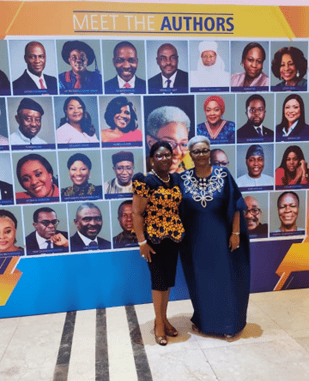
“She has not changed her base as a broadcaster but has presented herself in different ways—as someone who runs a non-profit organisation, a female media leader, an author and a mentor. She is a dreamer, a woman who is 72 and still dreaming,” Alaka said.
The WSCIJ Executive Director/CEO who also contributed a chapter to the publication, underscored the Centre’s connection to Oloyede’s enduring contributions to Nigeria’s media landscape. While reflecting on the lessons young media professionals can draw from Oloyede’s career, Alaka emphasised the importance of consistency, resilience and the willingness to keep showing up despite challenges.
“Bimbo Oloyede has been consistent and has shown the capacity to keep showing up, even when it was raining and stormy. Young professionals need to learn the consistency required to build relevance and leave a legacy,” she said.
The Chairman of the event, Dr Yemi Ogunbiyi, OFR, described Oloyede as the “Queen of female broadcasters in Nigeria”, expressing delight at the opportunity to honour her contributions to the broadcasting industry.
“I’m delighted that we are all here today to honour Bimbo Oloyede and celebrate the grace that she embodies,” Ogunbiyi said, describing the gathering as a tribute to the veteran journalist’s five decades of excellence in broadcasting.
Also delivering a goodwill message, Professor Andrew Haruna, Secretary-General of the Committee of Vice-Chancellors of Nigerian Universities, said Oloyede’s five decades of contribution to Nigeria’s media and communication industry represented more than a personal milestone.
He described it as a significant part of Nigeria’s national history and a body of professional experience that deserved to be preserved, studied and passed on to future generations.
During a fireside chat, Oloyede recalled the inspiration behind the publication, explaining that the idea of documenting her five decades in broadcasting took shape several years ago and that it took about two years to bring the book to publication.
She also acknowledged Alaka’s influence in encouraging her to proceed with the project after she shared the idea with her.
Reflecting on the transformation of Nigeria’s broadcasting industry over the past five decades, Oloyede noted significant changes in people’s activities, perspectives and motivations for engaging with the media.
She explained that the publication was conceived partly to help bridge the knowledge gap between the industry’s history and its current realities.
“The idea behind the publication is to ensure that we bridge the knowledge gap and understand what is actually happening in the media,” she said.
Former Minister of Education, Dr Oby Ezekwesili, congratulated Oloyede on her five decades of professional contribution and highlighted the critical role of the media in promoting accountability and strengthening democracy.
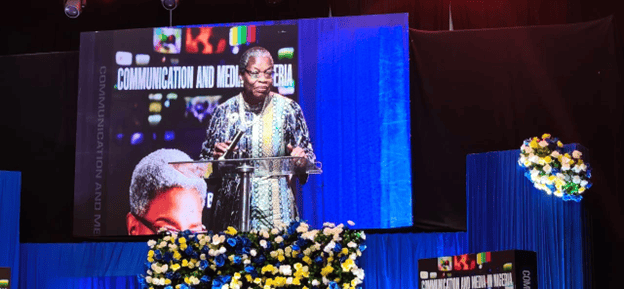
Ezekwesili stressed the importance of a credible press and an active civil society in holding government accountable, urging media practitioners to maintain professional integrity and continue to demand accountability from political leaders.
Reviewing the publication, Dr Reuben Abati described the book as valuable both for its production quality and the breadth of insights it offers. He said it would serve as a source of encouragement and inspiration for aspiring broadcasters and journalists.
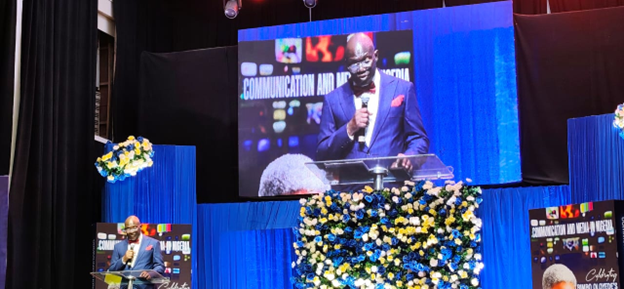
The 494-page publication comprises eight sections and 55 chapters, with contributions from media scholars and practitioners. The book examines a wide range of issues, from the history and development of Nigeria’s media to contemporary trends in new media, while emphasising the continuing role of journalism in holding leaders accountable.
The first section provides an overview of the history of the media, including the Nigerian media system and public relations. The second presents experiences and perspectives from media professionals, while the third examines newsroom practices and the challenges of intentionality in journalism.
The fourth section focuses on production and content creation across print and broadcasting. The fifth, titled “Training, Talent and Campus Broadcasting”, highlights the importance of nurturing emerging media professionals.
The sixth section examines the evolution of broadcasting and pronunciation challenges, while the seventh explores the rise of new media, artificial intelligence, and the growing roles of citizen journalists, bloggers, and influencers.
The publication concludes with a focus on the wellbeing of media professionals, offering reflections on achieving balance while navigating the demands of a challenging and rapidly changing profession.
Oloyede, 2015 recipient of WSCIJ’s Lifetime Award for Journalistic Excellence, continues to represent a model of resilience, reinvention, mentorship and sustained professional relevance in Nigeria’s media industry.