

Investigative journalism must be judged by the evidence it establishes, the systems it exposes and the difference it makes in people’s lives, rather than the volume of statistics it presents or the recognition it receives. This was the common position of panellists raised at the October edition of the Journalism & Society Conversations organised by the Wole Soyinka Centre for Investigative Journalism (WSCIJ).
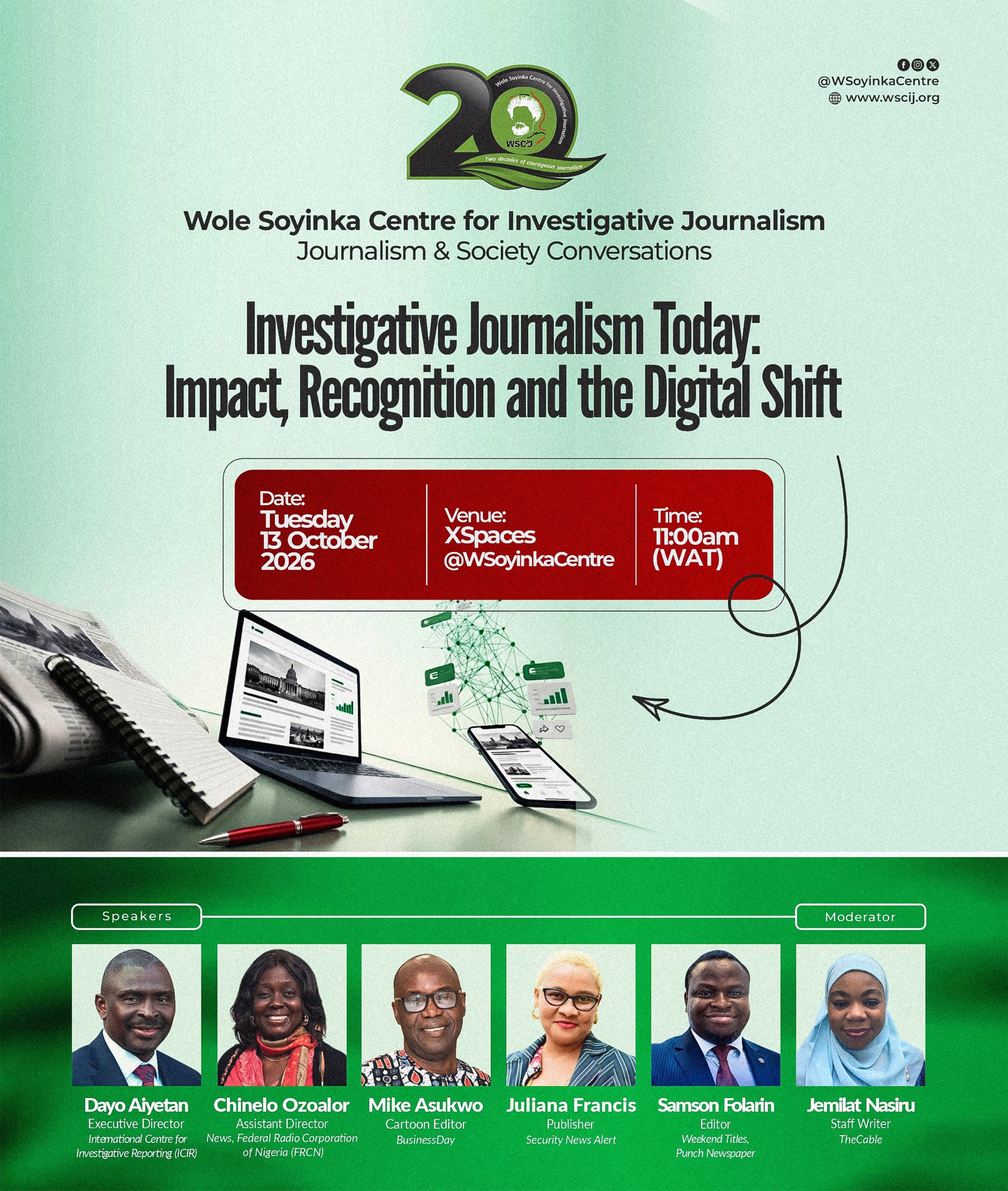
The conversation, held on Tuesday, 13 October 2026, on X Spaces, explored the theme, ‘Investigative Journalism Today: Impact, Recognition and the Digital Shift.’ It built on WSCIJ’s continuing efforts to strengthen accountability reporting through its various initiatives such as the Collaborative Media Engagement for Development, Inclusivity and Accountability (CMEDIA) project, which supports collaborative investigations, and its R.U.S.H. (Report Until Something Happens) approach to sustained reporting and follow-up.
Moderated by Jemilat Nasiru, Staff Writer at TheCable, the conversation featured Dayo Aiyetan, Executive Director of the International Centre for Investigative Reporting (ICIR); Chinelo Ozoalor, Assistant Director, News, Federal Radio Corporation of Nigeria (FRCN); Juliana Francis, Publisher of Security News Alert; Mike Asukwo, Cartoon Editor at BusinessDay; and Samson Folarin, Editor, Weekend Titles, PUNCH Newspapers. Adeolu Adekola, WSCIJ’s Senior Adviser, Programmes Development and Partnership, represented the Centre’s Executive Director, Motunrayo Alaka, at the virtual convening.
In her opening remarks, Alaka highlighted the need to balance the speed and relevance of news with accuracy and public interest. She reflected on the opportunities presented by artificial intelligence and other technologies, while stressing that journalists must ensure that the information they publish is accurate and responsibly verified. She also referenced a reporting on the arraignment of the Federal Institute of Industrial Research, Oshodi (FIIRO) former director-general over alleged certificate forgery, as an example of journalism’s role in bringing accountability issues to public attention.
Speaking from the lenses of a previous member of the Awards judges, Francis challenged journalists to look beyond statistics when developing investigative stories, stressing the importance of establishing what is being exposed and how the issue affects people. She argued that mentoring remains essential to helping reporters ask stronger questions, identify the human consequences of systemic failures and produce investigations grounded in evidence and people’s experiences. Referring to investigative reports, including a recent story involving “Professor” Anthony Kila, she emphasised that journalists should pursue investigations for their potential impact, not simply for recognition.
She also noted that digital tools have expanded the possibilities for investigative reporting, making it possible for stories to reach wider audiences when journalists are open to different approaches and formats. However, she cautioned that journalists using artificial intelligence must remain alert to hallucinations and verify the information it generates.
Folarin brought the newsroom perspective to the discussion, pointing to revenue pressures, limited capacity and shrinking newsroom resources as challenges facing investigative journalism. He said editors must weigh the public importance of a proposed investigation against the strength of the available evidence, the resources required and the potential impact of the findings.
He argued that a newsroom should be organised to both report breaking developments and investigate the systems behind them. While the daily desk can report an incident as it unfolds, other newsroom teams can deepen the reporting through sustained investigation. For him, being constantly occupied with reporting every development does not necessarily translate into impactful journalism; editorial judgement is needed to determine which stories deserve deeper attention. Referring to a recent investigative story by Investigative Journalist, Fisayo Soyombo, he underscored the importance of evidence-based reporting in helping audiences understand issues beyond the surface.
Aiyetan observed that technology has broadened the journalism landscape, creating more avenues for uncovering and communicating issues of public concern. He noted that investigative storytelling is no longer confined to traditional newsrooms or conventional formats, citing the online work of the activist, VeryDarkMan as an example of how digital platforms can be used to bring issues to public attention. However, he stressed that journalists must take deliberate steps to publicise their investigations and ensure the findings reach the audiences and institutions capable of responding to them.
He described investigative journalism as a means of exposing the gaps and shortcomings that prevent systems from working as they should.
Ozoalor reinforced the enduring accountability function of investigative journalism, noting that although tools and formats continue to change, its central mission remains the same. She also pointed to the need for newsroom leadership that actively encourages investigative reporting, observing that not every journalist is drawn to the demanding process. Supportive leadership, she suggested, is important to creating the conditions in which reporters can pursue deeper, more sustained stories.
Asukwo highlighted the growing range of tools available to investigative journalists, including blockchain tracing, satellite imagery and methods for tracing illicit financial flows. He argued that recognition remains important because it affirms the value of investigative work, while stressing that the same rigorous standards applied to written investigations should extend across all categories.
Focusing on editorial cartoons, he explained that visual storytelling can communicate across language barriers, make complex issues more accessible and help audiences remember important findings. Cartoons can also evoke empathy, depending on how an issue is presented, making visual journalism a meaningful part of the wider investigative landscape.
The discussion reinforced the need for investigations that combine strong evidence, human experience, editorial judgement and deliberate follow-up. It also highlighted the responsibility of journalists and editors to adapt to digital change without compromising the accuracy, independence and public-interest purpose that give investigative reporting its value.
The conversation comes as WSCIJ continues to receive entries for the 21st Wole Soyinka Award for Investigative Reporting (WSAIR). Journalists interested in entering are encouraged to visit the WSAIR application portal to review the award categories, eligibility requirements and submit their entries before the deadline.