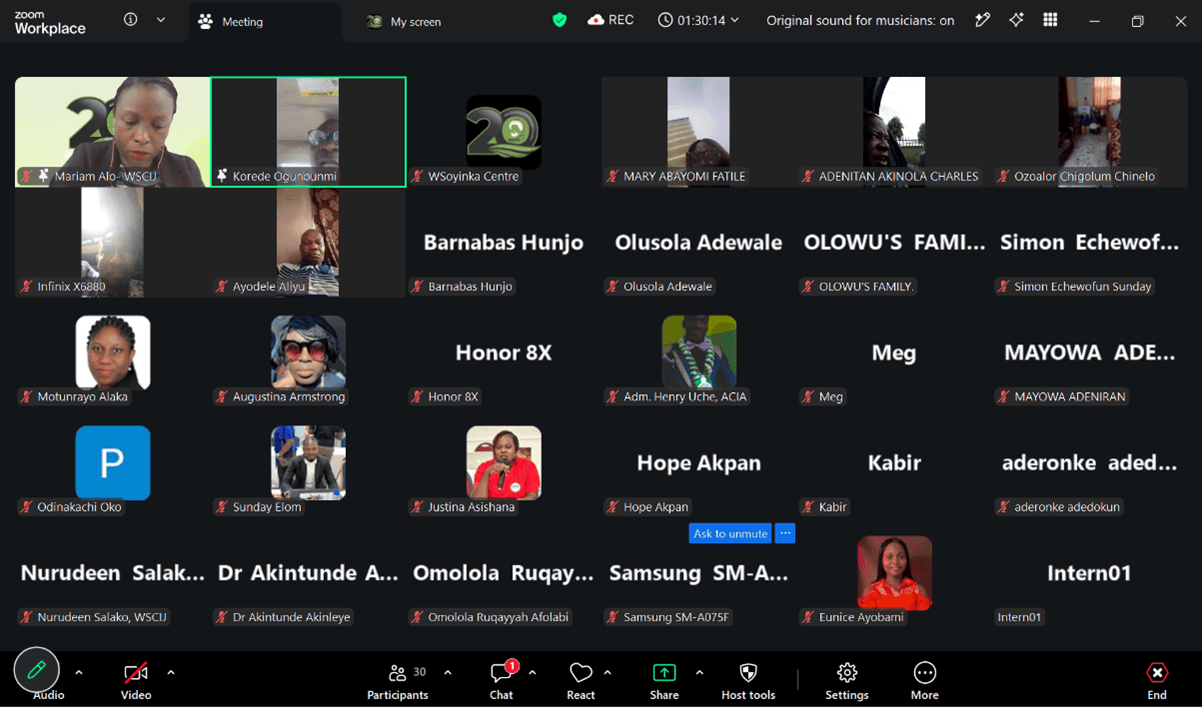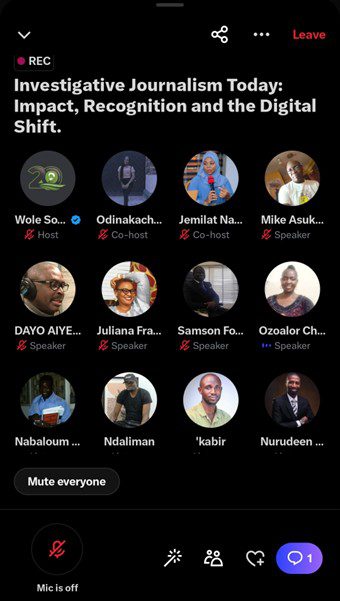
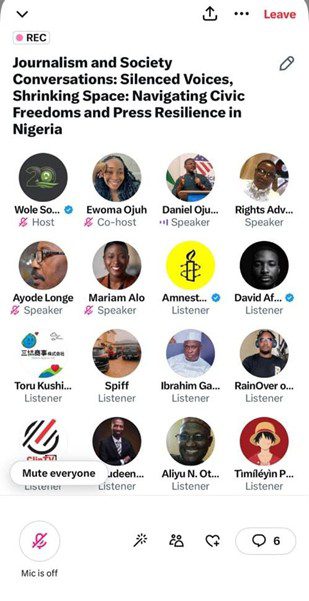
Experts, media practitioners, and human rights advocates gathered virtually on X Spaces for the August edition of the Journalism & Society Conversations, convened by the Wole Soyinka Centre for Investigative Journalism (WSCIJ).
Held under the theme “Silenced Voices, Shrinking Space: Navigating Civic Freedoms and Press Resilience in Nigeria,” the monthly public-interest dialogue unpacked the findings of WSCIJ’s recently released the 2025 Journalism and Civic Space Status Report, titled Silenced Voices, Shrinking Space: Civic Freedoms Under Pressure, which documented 245 civic space infractions across 570 media reports published by 54 media organisations.
The event commenced with opening remarks delivered by Mariam Alo, Programmes Officer at WSCIJ, who welcomed participants and highlighted that the critical objective of the dialogue was to address the rising administrative and legal pressures confronting civic actors, journalists, and media organisations in Nigeria. She stated that it set the tone for an engaging discussion on the state of press freedom and the urgent need for collaborative, cross-sectoral efforts to safeguard democratic accountability.
Following the opening remarks, the session was handed over to Judith Atibi, broadcast journalist and host of Breakfast Xtra on News Central, who moderated the panel of experts. She noted that when looking at the numbers from the report, they were staggering.
During the discussion, Daniel Ojukwu, Investigative Journalist with the Foundation for Investigative Journalism (FIJ), shared frontline perspectives on reporting under pressure and the growing use of legal and administrative measures against journalists. He noted that a society was only as free as its press and warned that if journalism was not protected, the immediate consequence would be a lack of public access to information, leading to a situation where people would remain uninformed and sycophancy would thrive. He also emphasised that money was crucial as the lifeblood of investigative journalism, and highlighted persistent bottlenecks with the Freedom of Information (FOI) Act. He shared that he had submitted an FOI request to the Lagos State Government in 2023 which had received zero response after three years of following up.
Furthermore, he pointed out the chilling effect on accountability reporting, noting that the imprisonment of whistleblower Nnamdi Emeh in Anambra had caused others to keep quiet for fear that the government would target them just as it targeted journalists. To combat these pressures, he advised that media houses must invest heavily in legal literacy for reporters so they could understand their rights during police encounters, and he emphasised that a more united media would make it harder to undermine press freedom.
Ayode Longe, Deputy Executive Director of Media Rights Agenda (MRA), examined emerging patterns of digital rights violations, noting that freedom of expression served as the foundation upon which every other right was built, meaning that if expression was suppressed, other rights would inevitably be heavily abused. He stressed that civic participation was a core principle of democracy and that meaningful participation became impossible if legal means were used to prevent people from speaking. Addressing the weaponisation of legislation, Ayode stated that the Cybercrime Act was intended to target individuals using the digital space to commit financial or human rights crimes rather than those engaging in reporting. He called instead for comprehensive legal reforms to amend laws that criminalised expression, alongside institutional overhauls within the police and the Department of State Services (DSS). He also advocated for a unified front, stating that stakeholders must stop working in silos and instead bring together journalists, unions, media freedom organisations, lawyers, and citizens.
Dr Lucas Koyejo, Coordinator, South-West Zonal Office, National Human Rights Commission, discussed institutional accountability and the mechanisms necessary to protect citizens’ rights and ensure justice. Highlighting the dangers of shrinking civic participation as the electoral cycle approached, he remarked that digital and social media platforms constituted critical areas where people expressed their views, adding that arresting individuals simply for posting their opinions online amounted to serious oppression. He strongly criticised the misapplication of legal frameworks, stating that the cybercrime act was designed to prevent criminals rather than repress the public, and decried its negative use against citizens. Dr Koyejo further called for strengthening existing legal protections rather than creating redundant laws, emphasising that truth and evidence should serve as the ultimate standard against defamation and censorship, while urging media practitioners to proactively utilise the NHRC’s existing complaint and protection mechanisms.
Discussions centred on the increasing reliance on non-violent administrative tactics, legal intimidation, and the imperative for cross-sectoral collaboration. Speakers emphasised that safeguarding Nigeria’s democracy required structural accountability from security agencies, legislative reviews of restrictive laws like the Cybercrimes Act, and fortified newsroom resilience.
Closing out the event, the panellists delivered powerful final words and calls to action. Daniel clarified that journalists were not asking for a free pass or immunity from the law, but rather for due process, the rule of law, and civil resolution through mechanisms such as an ombudsman or the Nigerian Press Council instead of the criminalisation of speech, while urging the public to understand these distinctions and join the collective fight for press freedom. Building on this, Ayode reminded participants that the price of freedom was eternal vigilance, stressing that state actors continuously sought to suppress expression and that citizens and the media must actively push back and monitor legislative actions closely. Lucas warned that a shrinking civic space served as an early indicator of democratic deterioration, emphasising that a government’s strength and legitimacy were measured by its willingness to tolerate peaceful criticism and provide effective remedies for rights violations.
Finally, Judith drew a poignant historical parallel, warning participants to beware the Ides of March, a famous phrase originating from William Shakespeare’s play Julius Caesar that served as a warning of impending danger and referred to the historic day Julius Caesar was assassinated by senators, including his close friend Brutus, which plunged Rome into a long period of political instability. She invoked this in light of the mounting pressures on civic spaces and transparency ahead of the electoral cycle, and called on all stakeholders across civil society, law, and the media to hold the line and protect democratic accountability.
Download the 2025 Journalism and Civic Space Status Report, titled Silenced Voices, Shrinking Space: Civic Freedoms Under Pressure.