Dear Partner,
Welcome to February. January gave us a moment to reflect on 20 years of impact, normalising accountability, supporting investigative journalism, and advancing accountability of newsroom on equity between men and women in the newsrooms and news. This month, our newsletter adopts a new title, “Investigative Insight” and flow. It reflects our focus on issues shaping investigative journalism and democracy. In this edition, we highlight our planned events on the intersecting themes of Radio and Diplomacy.

In a world of fragile diplomacy and global crises, radio continues to be the platform, especially in Africa, with the widest reach to the people. It bridges information, education, accountability and trust gaps for the important work of diplomacy.
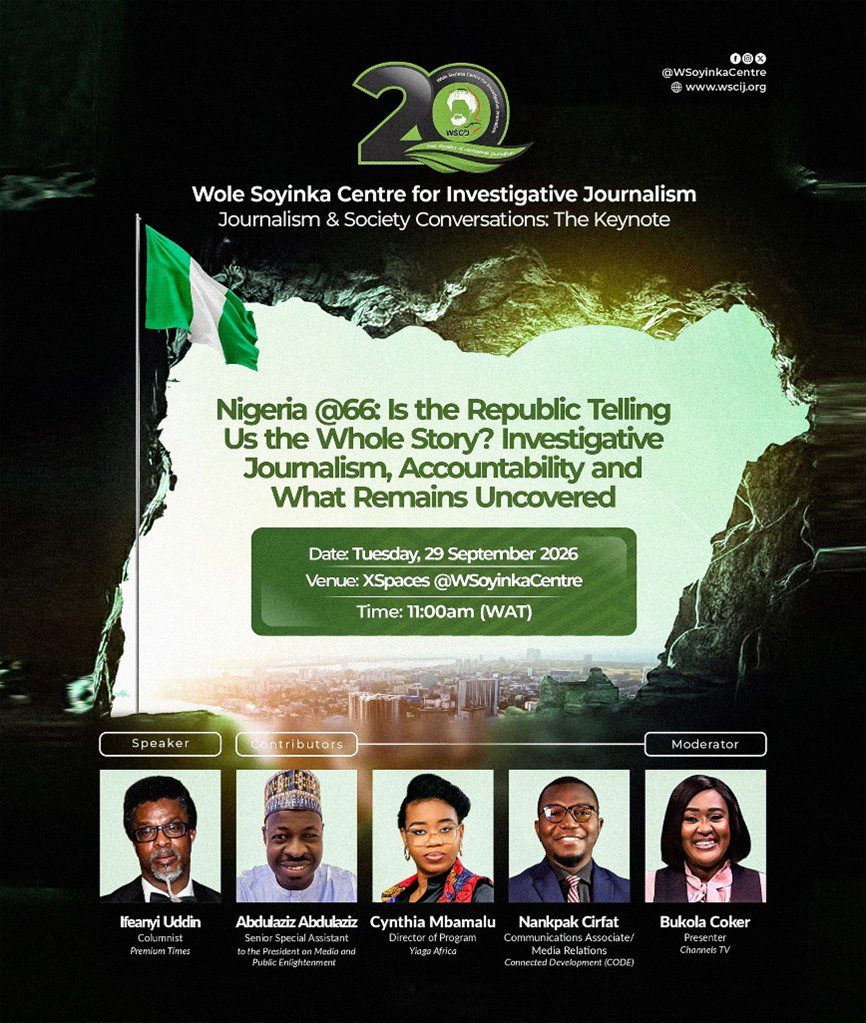
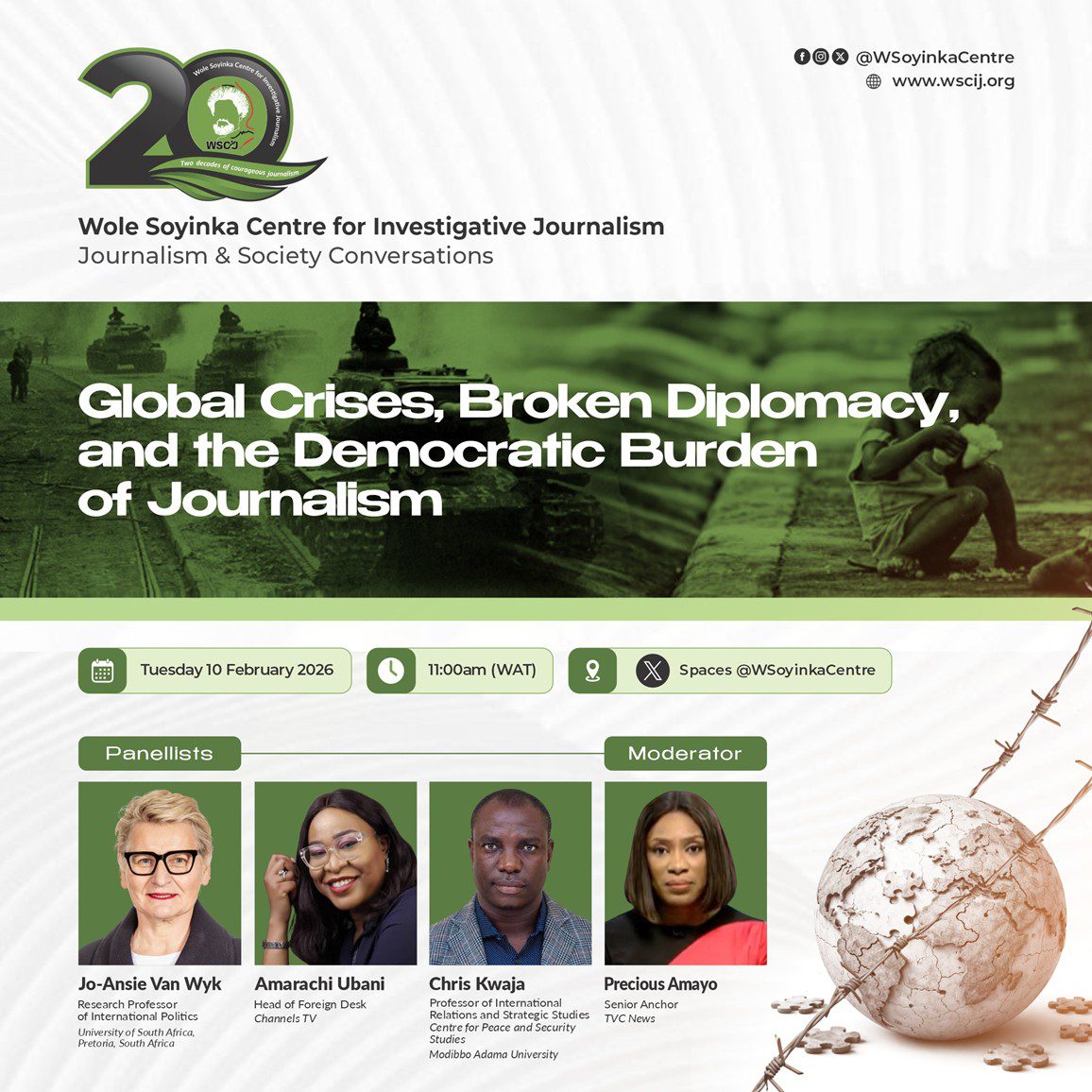
To this end, we will hold two editions of our Journalism & Society (J&S) Conversations this month on X (formerly Twitter). The first is the regular second Tuesday of the month event which will hold on Tuesday 10 February with the theme – Global Crises: Broken Diplomacy and the Burden of Journalism. The second, which is a pop-up Keynote edition of our J&S Conversation is to mark this year’s World Radio which is held annually on 13 February with the theme – to align with the United Nation’s “AI is a tool, not a voice” theme for the year.
Along these lines, our revised newsletter edition includes a spotlight on Women Radio 91.7FM’s an AI virtual assistant supporting women and integrating AI into broadcasting which was launched in 2024.
Motunrayo Alaka
Executive Director/CEO, WSCIJ
Opportunities for Journalists
- Apply Now for the CJID Online Platform Accountability Reporting Workshop.
- Write less, research more: The Thomson Reuters Foundation fully funded fellowship at Oxford awaits you.
- High-risk, high-impact journalism? The Knight International Journalism Award is for you.
Explore more fellowships, awards, and opportunities for journalists here.
Coming Next at WSCIJ
One Month, Two Conversations
Join our Journalism and Society Conversations this February on WSCIJ’s X handle, on Monday, February 10, to examine journalism’s role in a world shaped by diplomatic fractures.
On Thursday 13 February, attend “The Keynote”, a special edition of our monthly Journalism and Society Conversations to ask ‘Is Radio Still King? AI, Podcasts, and the Future of Voice & Trust’, in commemoration of World Radio Day.
  |
Journalists Hangout
On Friday, 25 February 2026, WSCIJ will convene a fun journalists hangout designed to encourage connection, shared learning, and open conversations about newsroom challenges.
Local journalism training
At the heart of what we do at WSCIJ, we believe that accountability starts at the local level. On Friday 27 February, we will hold a training for local radio journalists in order to strengthen community-based reporting and sustain coverage of issues that directly affect citizens at the local level.
This training will equip journalists with practical investigative skills while encouraging them to move beyond one-off stories and commit to persistent follow-up. Stay connected for updates on the call for applications. Details will be shared across our communication channels.
Inside WSCIJ – How we Showed up in January
Tax reforms are here to stay: experts, citizens tackle myths at WSCIJ conversation
As Nigeria advances its tax reform, experts say the reforms are inevitable but must be matched with accountability and trust. At WSCIJ’s first Journalism and Society Conversation of the year, tax experts, civil society actors, and journalists also examined widespread misconceptions and the growing public trust deficit surrounding the reforms. The discussion underscored the critical role of the media in promoting clarity, countering misinformation, and helping citizens understand the implications of tax policies.
Missed the live discussion? Listen to the full conversation here and stay informed.

Conversations on Pedagogy, Curriculum and Decolonisation in honour of BJ@80
Our first major event of the year, WSCIJ proudly hosted a symposium keynoted by Priyamvada Gopal Professor of Postcolonial Studies at the University of Cambridge, on ‘Pedagogy, Curriculum and Decolonisation’ in honour of Professor Biodun Jeyifo as he turned 80.
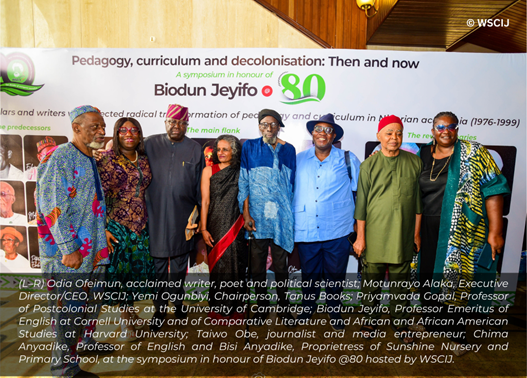
We have produced a four-part series from this important event, exploring insights on post-capitalist futures, decolonisation, education, and more, bringing together scholars, journalists, and the public for rich discussions – read, watch, and view photos on the conversations.
WSCIJ Staff Retreat Sets Clear Direction for Collaboration, Accountability, and 2026 Priorities
To start the year right, WSCIJ brought together staff and resource persons for a dynamic three-day retreat focused on reflection, planning, and alignment. Sessions emphasised cross-team collaboration, accountability, innovation, and strategies for resource mobilisation. Motunrayo Alaka, our Executive Director/CEO along with Taiwo Obe, Veteran Journalists and Abisola Olawuyi, Human Resource Specialist, outlined key priorities, including strengthening collaborations, scaling initiatives globally and raising funds to strengthen investigative journalism. The retreat reinforced WSCIJ’s dedication to excellence, teamwork, and public interest reporting. Read more
Journalism Today
Press freedom in a risky world
A recent report on the arrest of a journalist covering protests in Minneapolis underscores the physical and professional risks reporters face while documenting civil unrest. In Nigeria, stakeholders call for stronger protections of civic space and media freedom, emphasising the need for dialogue, collaboration, and lawful engagement between state and non-state actors. This formed the core of the public presentation of our 2024 Civic Space Status Report: Shrinking Freedoms. At the same time, a report by Reuters Institute shows that artificial intelligence is reshaping journalism, influencing both how audiences access information and how media organisations operate, presenting new opportunities and challenges for press freedom and accountability.
Voices from the field

AI in Investigative Journalism
Analyse large files with Google Pinpoint
Are you a journalist working with large documents, audio files, or data dumps? According to reviews, Google Pinpoint helps you search, organise, and analyse vast amounts of information in minutes, not hours. The tool allows you to scan documents, transcribe audio, identify key names and locations, and uncover connections that might otherwise be missed, making investigative and fact-checking work faster and more precise.
👉 Learn practical ways to use Pinpoint.
Investigative reporting is the vital force for the restoration of human dignity. — Wole Soyinka