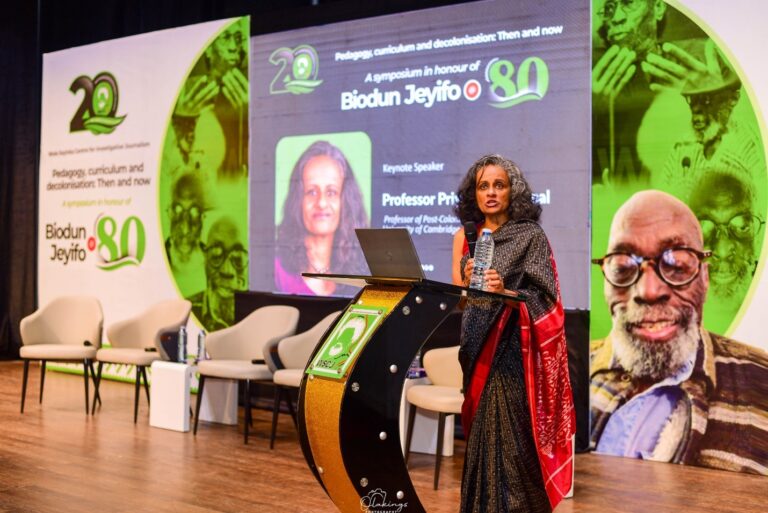
The keynote lecture for Professor Biodun Jeyifo’s 80th birthday symposium, titled “Who is Afraid of Decolonization?” was delivered by Priya Gopal of Cambridge University. Gopal, a former student of Jeyifo at Cornell University, framed her presentation around the concept of “arrested decolonization,” a term originally developed by Jeyifo to describe the stalling of the liberation project in the post-colonial world.
Before diving into theory, Gopal recalled her “baptism of fire” as BJ’s doctoral student 30 years ago. She shared that a long, handwritten letter from him changed her academic trajectory by advising her not to waste time on “arid abstract arguments” with theoreticians, but rather to “let the text speak” and respect its internal arguments. This pedagogical foundation informed her approach to decolonization as a living history rather than a mere academic trend.
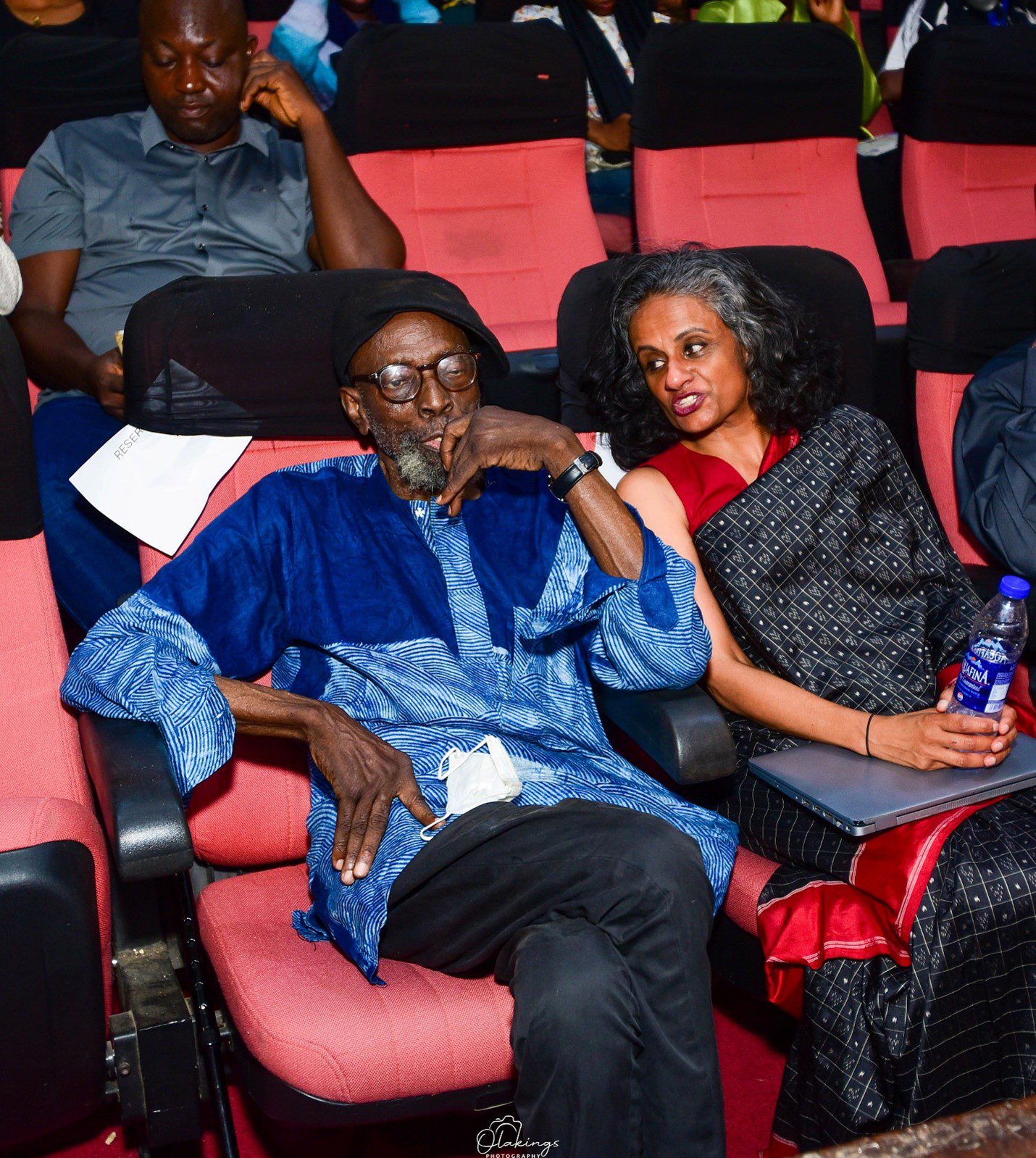
Gopal argued that decolonisation remains a necessary, albeit “arrested,” project. She noted that while “flag independence” was achieved in the 1950s and 60s, the deeper process of transformation was often “hijacked or twisted into something else entirely”. According to her, the condition of the Global South is one where the apparatus of the colonial state—including police, military, and legal systems—was left intact and used for repressive purposes in the name of the new nation-state.
Drawing on the 1955 Bandung Conference and the 1956 Paris Congress of Black Writers and Artists, Gopal emphasized that the early leaders of the decolonization movement viewed themselves as “agents of history” rather than victims. She countered recent critiques that suggest decolonization has become a “facile catchall” for victimhood, arguing instead that it is a “full-spectrum project of remaking the world itself”.
Professor Priya linked the historical “spirit of 1492,” the era of imperial decimation—to the contemporary “genocidal conjuncture” witnessed in Gaza. She stated that the current global order remains “inhospitable for the majority” and is characterized by extraction and wealth concentration, which she equated with the core dynamics of colonialism and capitalism. She urged that decolonization must involve a qualitative change in how humanity organizes itself, moving away from the “sclerosis” of colonial elites.
The lecture concluded with the idea that the work of decolonization is the “work of the imagination.” This sentiment was later echoed by Professor Jeyifo himself, who asserted that humans have “no future that is not post-capitalist,” and that competition must take a back seat to cooperation for the species to survive.
In the final part of this series, we looked at Biodun Jeyifo’s own reflections on his big day. Click here to read the story.