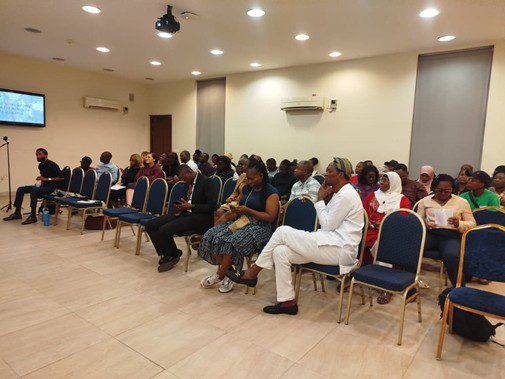
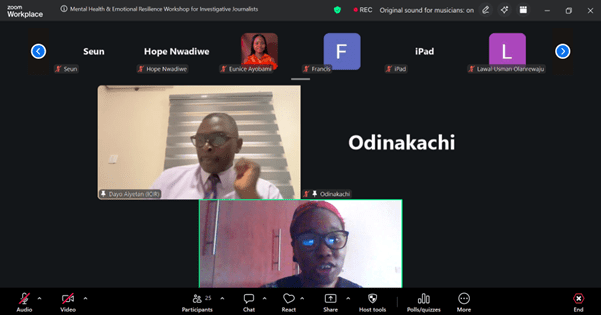
To promote and protect the mental health of journalists, the Wole Soyinka Centre for Investigative Journalism (WSCIJ) convened its mental health training under the Civic Space Guard project, to strengthen the resilience of journalists while advancing conversations around safety, wellbeing, and the sustainability of investigative reporting.
Research by the International Society for Traumatic Stress Studies shows that up to 95 per cent of journalists are exposed to potentially traumatic events in the course of their work, while findings highlighted by the Aljazera Media indicate that a significant proportion of journalists globally experience mental challenges, with some exhibiting symptoms of post-traumatic stress disorder (PTSD). These findings further amplify the need for structured mental health support and resilience-building interventions.
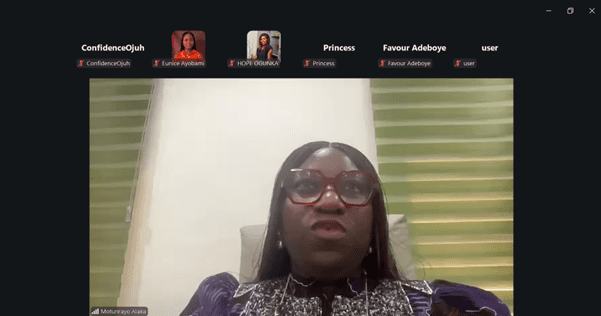
Opening the session, WSCIJ Executive Director/CEO, Motunrayo Alaka, underscored the often-overlooked emotional burden journalists carry in the line of duty. She highlighted the relentless demands of the profession tight deadlines, constant movement, and repeated exposure to distressing and sometimes gory content as key drivers of mental strain.
“Mental health training is very dear to me because it helps bring awareness to the realities journalists face,” she said, referencing storytelling experiences such as EbonyLife’s work on Oloture and her LinkedIn post on ‘when a story kills the storyteller.’ She added that while a single training cannot resolve all the challenges, it is critical in normalising conversations around therapy and support systems.
“We are working towards ensuring that journalists have access not just to mental health support, but also to legal support, because legal pressures are also a major part of the burden journalists carry,” Alaka noted.
To gauge participants’ experiences, a live poll conducted during the session revealed that the majority of respondents reported feeling stressed on the job at varying levels, with a significant number indicating they are “often stressed.” The responses reinforced the urgency of creating safe spaces for reflection and equipping journalists with coping mechanisms.
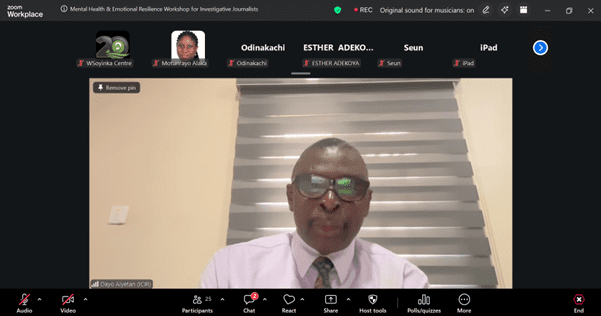
Executive Director of the International Centre for Investigative Reporting (ICIR), Dayo Aiyetan, further emphasised that stress is deeply embedded in the nature of journalism itself.
“A whole lot about journalism is stressful, and journalists need to know that help exists,” he said.
Drawing from insights in the Hidden Cost of Investigative Journalism, Aiyetan stressed that the psychological impact of investigative reporting is real and, if ignored, can undermine both the wellbeing of journalists and the quality of their work.
“The psychological impact of investigative journalism is real. Ignoring it damages both the journalist and the journalism we do,” he said.
He highlighted both primary and secondary trauma experienced by journalists, noting symptoms such as chronic fatigue, emotional exhaustion, cynicism, and reduced motivation. He also pointed to the moral burden journalists often carry, especially when covering vulnerable populations without being able to directly intervene.
“Sometimes, journalists feel victimised because they cannot help the people whose stories they tell. Understanding your role helps you protect yourself from that moral injury,” he explained.
Aiyetan outlined practical strategies for managing stress, including limiting repeated exposure to distressing content, maintaining clear work-life boundaries, sharing emotional burdens with colleagues, and adopting structured rest periods. He also addressed the growing impact of digital harassment, advising journalists to consciously disengage from harmful online interactions.
“Online harassment is designed to silence investigative journalists. You must not allow it to define your reality,” he said.
He further stressed the importance of risk assessments, peer support systems, and institutional responsibility in safeguarding journalists’ wellbeing.
Adding a clinical and psychological perspective, mental health expert Dr. Adekoya reminded participants of the critical link between mental wellbeing and professional effectiveness.
“Every day, you stand at the intersection of truth and pressure. If the one holding the line is not internally okay, the line will break,” she said.
She emphasised that the mind plays a central role in shaping how journalists interpret and respond to their experiences.
“What you constantly think influences your emotions, and your emotions drive your actions. An untrained mind can amplify anxiety, fear, and other negative states,” she noted.
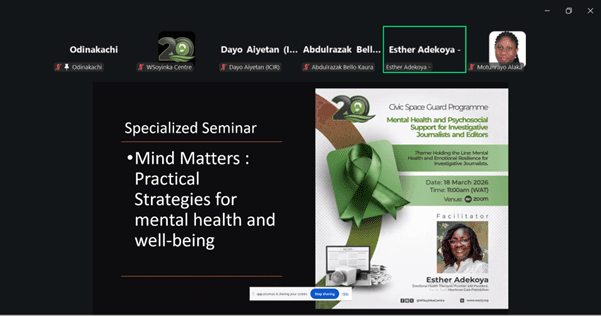
Founder and president of Heartrose Care Foundation, Dr. Esther Oyebola Adekoya encouraged participants to prioritise self-awareness and emotional honesty, stressing that self-care is not optional but essential.
“You cannot pour from an empty cup. Self-care is how you take your power back,” she said, echoing the widely cited notion that “self-care is giving the world the best of you, instead of what’s left of you.”
She also guided participants through practical techniques, including breathing exercises, emotional regulation strategies, and recognising early warning signs of stress and burnout. Another poll during the session showed that many participants felt increasingly confident in identifying these warning signs after the training.
Throughout the session, participants engaged in reflective exercises and discussions on finding meaning and purpose in their work, despite the pressures that come with it.
The training forms part of WSCIJ’s broader efforts under the Civic Space Guard project to not only protect journalists from external threats but also address the internal challenges that can undermine their effectiveness and wellbeing. By fostering awareness, promoting resilience, and advocating for institutional support, WSCIJ continues to strengthen the capacity of journalists to “hold the line” for truth, accountability, and justice.