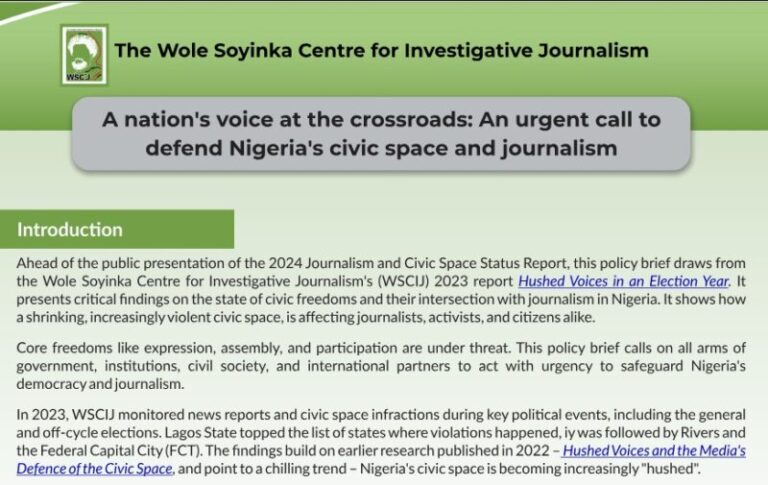
The Wole Soyinka Centre for Investigative Journalism (WSCIJ) has released a new policy brief titled “A nation’s voice at the crossroads: An urgent call to defend Nigeria’s civic space and journalism.” The document explains the current state of civic space in Nigeria, highlights growing threats to press freedom, and offers clear suggestions for how government, security agencies, media, and civil society can respond.
WSCIJ has been tracking violations against civic space for years. In 2022 and 2024, we published two major reports—Hushed voices and the media’s defence of civic space and Hushed voices in an election year. These reports cover 11 years of data and show a steady rise in attacks on the media and civil rights. The police appeared most frequently as the institution responsible for these violations.
We launched the Civic Space Guard project in 2021 during the 16th Wole Soyinka Award for Investigative Reporting (WSAIR) to specifically address the need to engage stakeholders on ways to prevent a closing civic space. Since then, we have hosted conferences and meetings with journalists, civil society, lawyers, and security officials. The goal is simple: to protect the space where Nigerians can speak, assemble, and hold leaders accountable.
Other organisations are contributing to this important conversation. Last week, the Centre for Journalism Innovation and Development (CJID) launched the Nigeria Openness Index, the country’s first national ranking of civic space and press freedom. The report covers all 36 states and the FCT, using data from over 1,100 journalists and civil society actors. It measures issues like journalist safety, internet freedom, and government transparency.
At the launch event, our Executive Director/CEO, Motunrayo Alaka, joined a panel of experts to discuss the report’s findings. Speaking on the Report Until Something Happens (RUSH) model she designed, Alaka emphasised that “Democracy is local. Development is local. Journalism that must make a difference must also be local.”
Also recently, the Media Rights Agenda (MRA) released a report titled “The Onslaught Intensifies: A Mid-Term Assessment of Media Freedom under the Tinubu Administration.” The report looks at how press freedom has fared in the first two years of the current government. It covers legal and physical threats to journalists, including digital surveillance and attacks.
All these efforts point to the same thing: Nigeria’s civic space is under pressure. But this is not just a media problem or a civil society problem; it concerns everyone. The release of this policy brief is not just a report—it is a call to action. It reflects WSCIJ’s deep commitment to protecting the rights of citizens, supporting independent journalism, and holding power to account. As the lines between democratic openness and authoritarian tendencies continue to blur, we believe that a free press, an active civil society, and a protected civic space are essential to Nigeria’s progress.