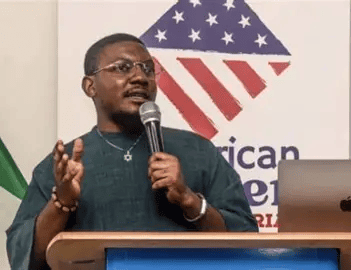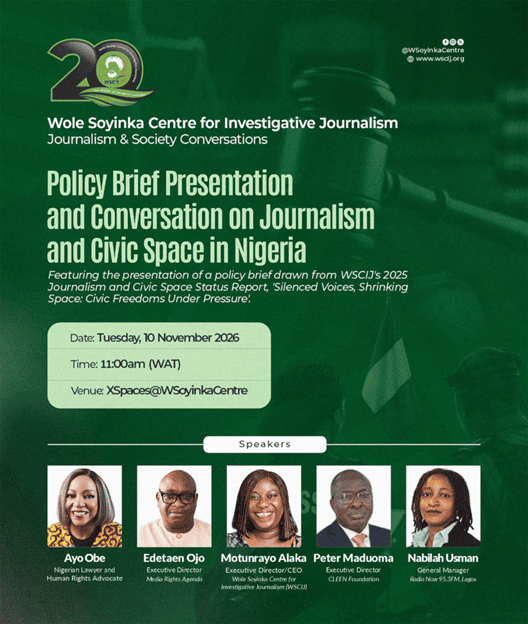
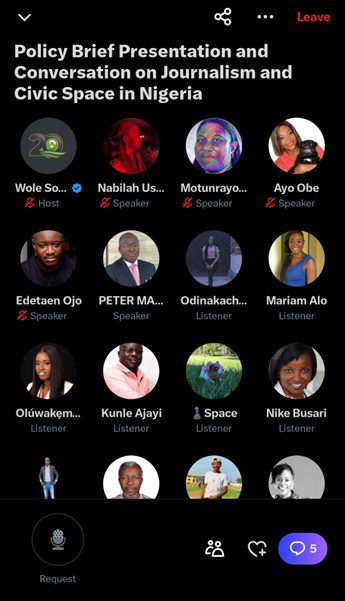
Persistent violations against journalists, citizens and other civic actors in Nigeria have renewed calls for stronger institutional accountability and safeguards to protect civic space. The need for these measures formed the focus of discussions at the launch of the Wole Soyinka Centre for Investigative Journalism (WSCIJ)’s 2025 Journalism and Civic Space Status Report Policy Brief, held during the Centre’s monthly Journalism & Society Conversations on Tuesday, 10 November 2026.
Moderated by Nabilah Usman, General Manager Radio Now 95.3 FM, the engagement brought together stakeholders including Superintendent of Police Kondom Joseph, representing the Nigeria Police Force’s New Media office; Ayo Obe, Human rights lawyer and activist; Edetaen Ojo, Executive Director, Media Rights Agenda (MRA); Motunrayo Alaka, Executive Director/CEO, WSCIJ; and Peter Maduoma, Executive Director, CLEEN Foundation, to examine the state of civic freedoms in the country and consider practical steps towards creating a safer environment for journalists and citizens.
The conversation was informed by findings from WSCIJ’s 2025 Journalism and Civic Space Status Report, Silenced Voices, Shrinking Space: Civic Freedoms Under Pressure, which documented 245 incidents of violations across 570 media reports from 54 media organisations. State actors accounted for 219 incidents, representing 89.4 per cent of the total, while non-state actors were linked to 26 incidents.
In her opening remarks, Motunrayo Alaka, emphasised that the safety of journalists cannot be separated from the broader protection of civic space. She explained that the Centre’s monitoring captures incidents reported in the media and is therefore not an exhaustive account of all violations. She also highlighted limitations in monitoring broadcast media and other forms of content that may not remain accessible.
Alaka noted that the figures should be understood within the context of the Centre’s monitoring approach and the wider civic environment. She pointed to recurring spikes around elections and protests, while drawing attention to incidents occurring beyond these settings, including at government houses and court premises. She stressed the need for continued documentation, institutional engagement and a stronger commitment to addressing threats against journalists and other civic actors.
Presenting the policy brief, Time to Act to Safeguard Journalism and Civic Space in Nigeria, Edetaen Ojo, highlighted the need to translate existing commitments to press freedom and civic rights into measurable institutional action. Among the recommendations discussed were clearer operational guidelines for security agencies, sustained training for personnel, improved monitoring and evaluation, and adequate funding to support implementation.
Ojo also identified impunity as a major obstacle to protecting journalists, arguing that the problem extends beyond a lack of awareness among security personnel. He called for effective investigation of misconduct and the activation of existing accountability mechanisms within security institutions. He further advocated a collaborative national framework that would bring relevant stakeholders together to develop guidelines, complaints procedures and monitoring arrangements suited to the different institutions involved.
Responding from the perspective of the Nigeria Police Force, SP Kondom Joseph, acknowledged the report and outlined ongoing efforts to strengthen police capacity ahead of the 2027 elections. He disclosed that 10,000 police officers were undergoing election security management training across 18 states and the Federal Capital Territory, in collaboration with the Nigeria Police Trust Fund. The training, which commenced on 22 October 2026, covers crowd control, conflict prevention, rules of engagement, human rights, intelligence gathering and responses to election-related incidents.
Joseph also pointed to existing police complaint channels, including the Complaint Response Unit and Public Complaint Bureau, as mechanisms through which allegations of misconduct can be investigated. He maintained that journalists should be regarded as partners in the discharge of police responsibilities.
However, the discussion raised questions about the effectiveness, independence and transparency of accountability processes, particularly where allegations involve security personnel. The existence of training programmes and complaint mechanisms, panellists noted, must translate into demonstrable changes in conduct and consequences for violations.
Human rights lawyer, Ayo Obe brought attention to the constitutional basis of freedom of expression and the press, noting that these rights belong to all citizens and are not privileges reserved for journalists. Referring to Section 39 of the Nigerian Constitution, she warned against the use of laws relating to criminal defamation and cybercrime to intimidate critics or punish people for expressing views that may embarrass public officials.
Obe also questioned the exercise of police discretion in cases involving influential individuals, noting that arrests and prolonged detention can become instruments of harassment even where allegations are weak. She stressed that public officials must be able to tolerate criticism and that the criminal justice system should not be manipulated through delayed proceedings or other processes that impose punishment before a case is properly determined.
For Peter Maduoma, the report reflected a persistent gap between security institutions and the communities they are mandated to serve. He noted that although there had been progress in some areas, rights-based policing remained a significant concern, with issues such as unlawful detention, police brutality and the use of excessive force continuing to affect public confidence.
Maduoma advocated a whole-of-society approach to security sector reform, emphasising that journalists, civil society organisations and citizens have important roles in holding institutions accountable. He called for sustained engagement, community-level solutions and adequate investment in the personnel, equipment and resources required to improve policing. He also stressed that training must be continuous, particularly as officers are transferred, retire or assume new responsibilities.
Beyond the conduct of security institutions, the conversation also considered the responsibility of the media to uphold professional standards and defend civic freedoms. Alaka observed that media organisations do not always formally report incidents involving their journalists, with some cases treated as part of the risks associated with the profession. She called on editors, newsroom leaders and professional associations to take a more active role in documenting violations, seeking redress and supporting affected journalists.
The discussion also acknowledged the need for accountability within the media itself, particularly in addressing partisan reporting and professional misconduct. Speakers highlighted the importance of using existing media accountability structures and strengthening internal mechanisms rather than allowing concerns about media standards to justify heavy-handed state intervention.
The engagement reinforced the need to move beyond periodic conversations towards sustained action, with clear responsibilities, monitoring processes and evidence of implementation. It also highlighted that protecting journalists requires more than responding to individual attacks: it involves safeguarding the rights of citizens to express themselves, assemble, protest and participate in public life.
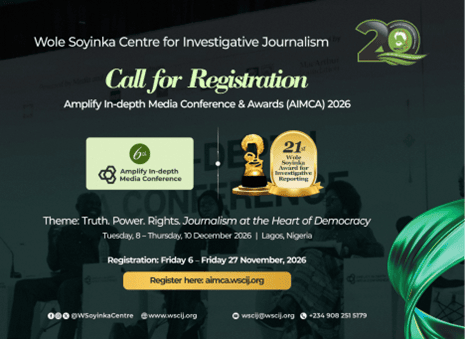
As conversations around the safety of journalists and the protection of civic space continue, it is equally important to recognise and celebrate journalism that holds power to account and serves the public interest. This is the spirit behind the 6th Amplify In-depth Media Conference and the 21st Wole Soyinka Award for Investigative Reporting (AIMCA 2026), holding from Tuesday to Thursday 10 December 2026 in Lagos, Under the theme “Truth. Power. Rights. Journalism at the Heart of Democracy”. AIMCA will bring together journalists, media leaders and other stakeholders for critical conversations on the future of journalism and democracy, while celebrating outstanding investigative reporting. Registration is now open. Visit aimca.wscij.org to register and be part of the conversation.