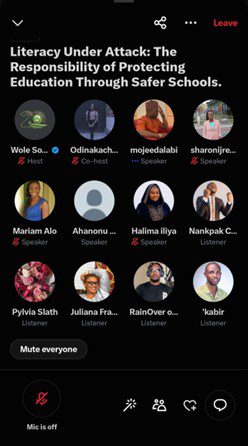
The safety of schools, disruption of learning, and the accountability of institutions responsible for protecting education took centre stage as the Wole Soyinka Centre for Investigative Journalism (WSCIJ) convened stakeholders for the September edition of its Journalism & Society Conversations on Tuesday, 8 September 2026.
Held to mark International Literacy Day and the International Day to Protect Education from Attack, the conversation, themed “Literacy under Attack: The Responsibility of Protecting Education through Safer Schools,” examined the growing threat insecurity poses to education in Nigeria, while interrogating whether existing government policies, institutions and interventions are translating into safer learning environments.
The conversation forms part of WSCIJ’s longstanding work on education accountability through its Regulators Monitoring Programme (REMOP) supported by the MacArthur Foundation, launched in 2017 to use journalism to examine challenges affecting access to basic education.
Moderated by Sharon Ijasan, Senior Investigative Reporter at TVC News, the conversation featured Mojeed Alabi, Investigative Journalist and Team Lead, DevReporting; Halima Iliya, National Coordinator, Safe School Program; and Odinakachi Ahanonu, Policy Advisor/National Coordinator, Civil Society Coalition on Education for All (CSACEA).
Speaking from the perspective of the Safe School Initiative, Iliya established that protecting schools requires a coordinated response that extends beyond physical infrastructure. She explained that the Safe Schools programme has established designated desk officers, engaged communities and strengthened community-level responses, with the aim of encouraging communities to take ownership of school safety.
Iliya noted that these efforts include community engagement, the use of local languages and the involvement of local actors, including hunters and vigilantes, in strengthening security around schools. On what needs to change, she called for greater synergy among stakeholders and stressed that “we need to transform commitment into action,” including sustained investment in school infrastructure, lighting and other safety measures.
Approaching the issue from an investigative journalism perspective, Alabi examined the broader dimensions of the threat to education, noting that attacks on schools are not the only indication that education is under pressure. “It is not just about physical attacks. Our education is really under attack,” he said, pointing to declining confidence in education and the wider safety crisis beyond school walls.
Alabi further highlighted the need for stronger data, accountability and institutional responsibility, questioning the absence of reliable information on the number of pupils and students in the country. He stressed that journalists must move beyond reporting to sustained advocacy and monitoring, noting that “journalists should not just write and sit back. Beyond reporting, we must engage seriously in advocacy.”
Ahanonu examined the issue from the perspective of civil society advocacy and policy implementation. She noted that communities should not be viewed merely as beneficiaries of school safety interventions but as active participants in protecting children. “We need to start moving away from seeing communities as beneficiaries and start seeing them as part of the system,” she said, emphasising the importance of trust and stronger collaboration between communities and government.
Ahanonu further highlighted the need to translate existing safe-school policies into practical action, including adequate emergency funding, trained personnel and stronger institutional capacity. She emphasised that protecting children is a collective responsibility, calling for “every hand” to be on deck to ensure that schools remain safe.
Across the discussion, speakers agreed that protecting education from attack requires more than emergency responses after incidents occur. They called for stronger implementation of existing commitments, improved coordination among government institutions, adequate funding for school safety measures, stronger community engagement and sustained accountability. The conversation also underscored the role of journalists and civil society organisations in monitoring commitments, documenting violations and ensuring that school safety remains a public accountability issue beyond moments of crisis.
The September Journalism & Society Conversations emphasised that journalism has an important role to play, not only in documenting what happens when schools are attacked, but in investigating the decisions, resources, systems and institutional failures that determine whether children can safely remain in school. The dialogue came against the backdrop of recurring attacks and abductions targeting schools across the country, including the 29 June 2026, attack on Government Day Secondary School, Lassa, Borno State, in which 36 students and a staff member were abducted.