The Wole Soyinka Centre for Investigative Journalism (WSCIJ) has called for stronger protection of civic space, press freedom, and digital rights in Nigeria, as media experts and civic actors warn that artificial intelligence, misinformation, and state pressure are reshaping democratic engagement.
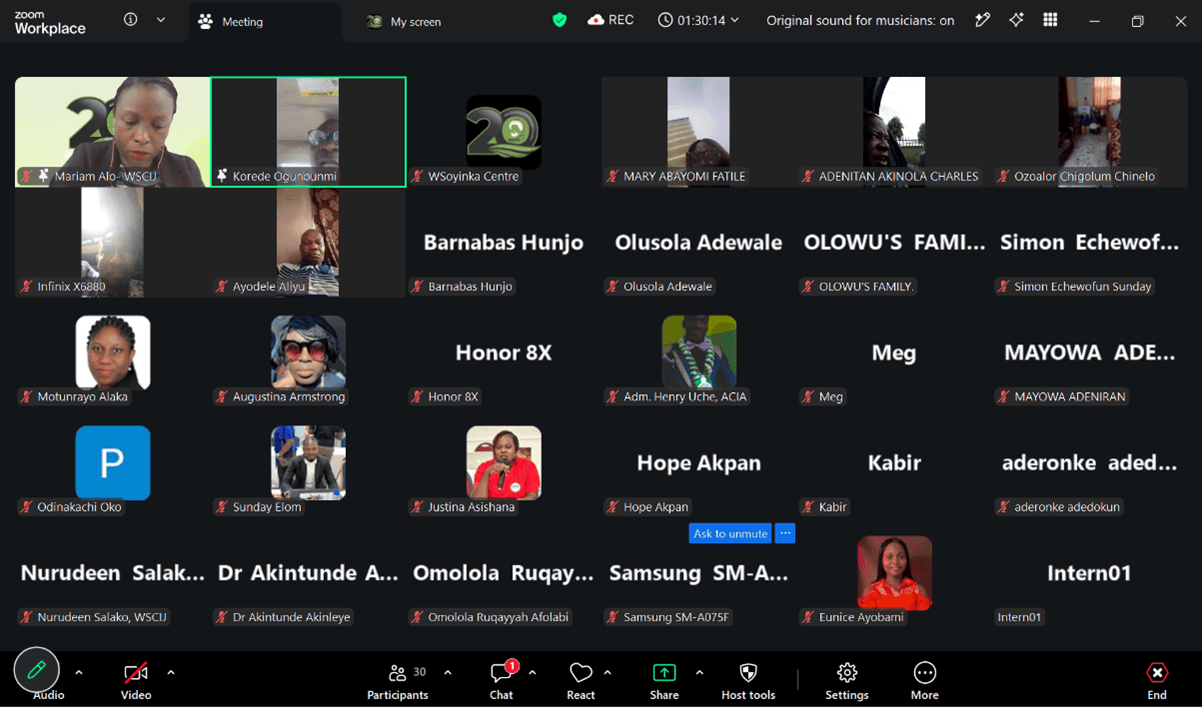
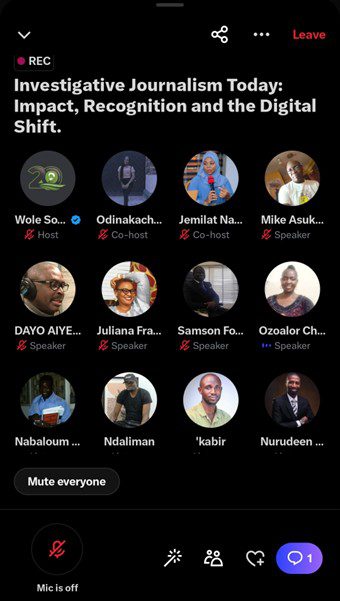
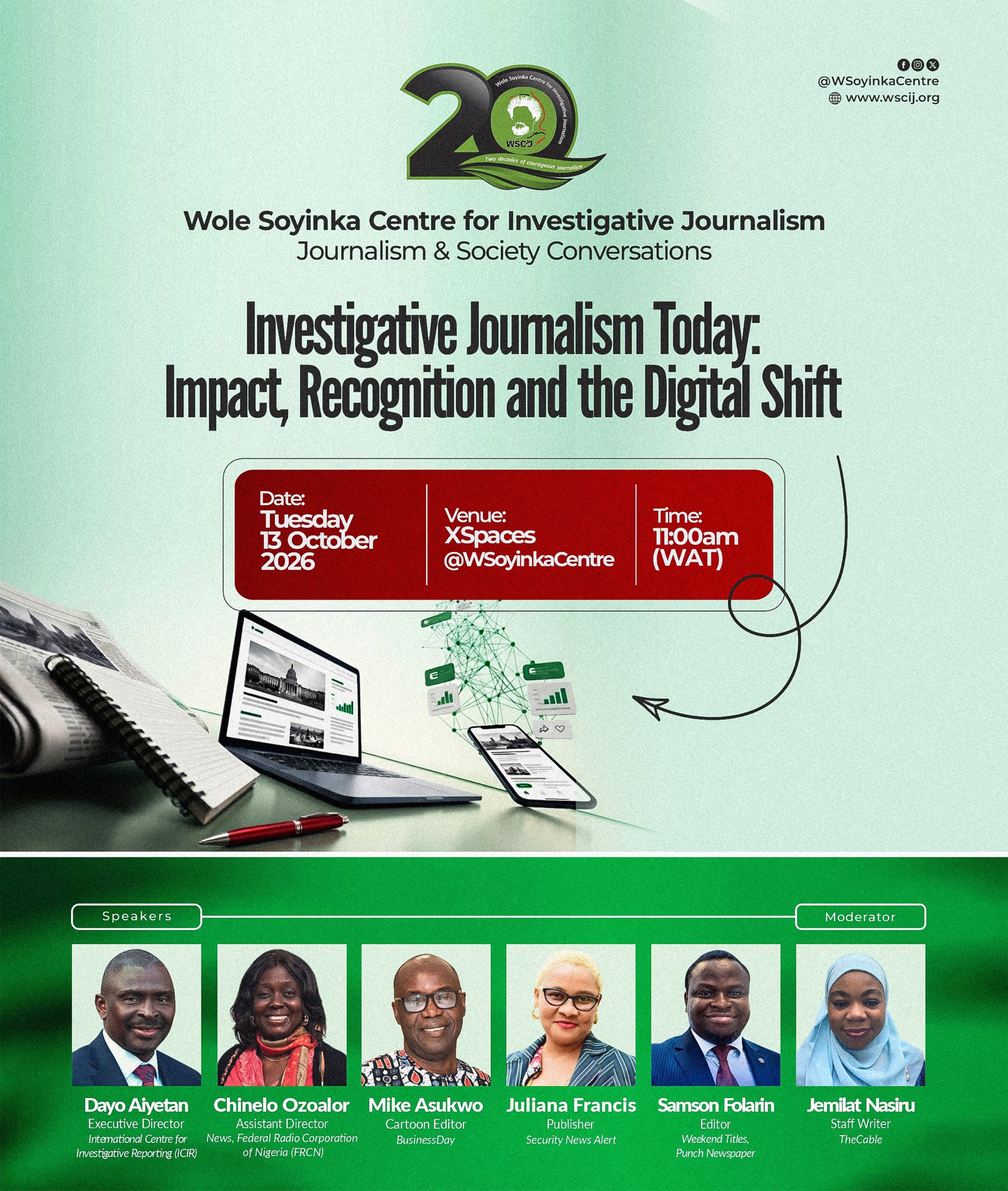
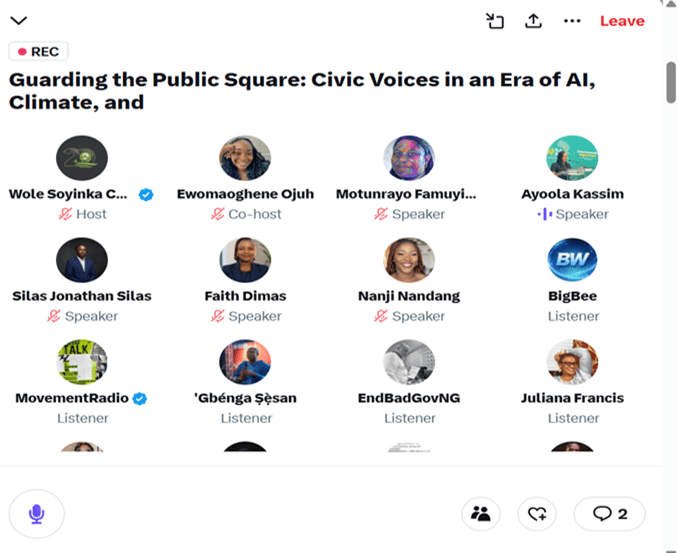
The call was made during the May 2026 edition of the Journalists & Society Conversations, an X space organised by WSCIJ to mark the World Press Freedom Day. The session was themed: “Guarding the Public Square: Civic Voices in an Era of AI, Climate, and Democratic Strain.”
The conversation brought together leading voices in journalism, digital rights, civic technology, and investigative reporting, including Gbenga Sesan, Executive Director, Paradigm Initiative; Ayoola Kassim, Assistant Controller of Programmes, Channels Television; Silas Jonathan, Digital Investigations Manager at the Centre for Journalism Innovation and Development (CJID); Nanji Nandang, a journalist with the International Centre for Investigative Reporting (ICIR); and Mwanret Dimas, a legal and civic-tech advocate at Citizens’ Gavel. The session was moderated by Kaladakoru Batubo, a broadcast journalist at Bonny FM.
In her opening remarks, Motunrayo Alaka, Executive Director/Chief Executive Officer at WSCIJ, said the “public square” has evolved beyond physical spaces to include digital platforms where citizens engage, organise, and influence society. Alaka added that while AI, climate change, and democratic pressures present serious challenges, the conversation should also focus on resilience and constructive solutions rather than fear.
According to her, journalism cannot be separated from the realities of its time, including technological disruption, climate pressure, economic instability, and information disorder. She emphasised that the civic space must be collectively protected just as the Centre through its civic guard space programme took that responsibility to guard the civic space, noting that societies thrive when citizens can speak, participate, question, organise, report and engage freely and responsibly.
Speaking during the session, Silas Jonathan observed that artificial intelligence has significantly complicated the information ecosystem in Africa. He noted that AI has enabled “plausible deniability,” where public officials disown accountability-related content by claiming it is AI-generated.
According to him, this development undermines journalistic accountability and weakens public trust in verified information. He also highlighted the rise of deepfakes, bot-driven propaganda, and AI-generated content during elections, describing them as tools used to distort democratic narratives and manipulate public perception. Silas further cautioned that in an era where “seeing is no longer believing,” journalists must urgently strengthen verification skills and adopt new tools for digital accountability.
On the question of civic freedom, Gbenga rated Nigeria’s civic space three out of 10, citing incidents of arrests, harassment, and intimidation of citizens and journalists. He referenced cases of social media users allegedly detained over critical commentary, as well as reports of surveillance and spyware use against protesters. He argued that fear of reprisals is leading to self-censorship, weakening democratic participation. “A system where citizens feel unprotected will eventually silence itself,” he said.
Nanji highlighted the risks faced by investigative journalists, noting that exposing powerful interests often attracts legal threats, intimidation, and institutional resistance. She referenced documented attacks on journalists and media organisations across multiple states, stressing that accountability for such violations remains low. She further warned that the lack of consequences for attacks on journalists creates a cycle of impunity that undermines press freedom.
Discussing Nigeria’s legal environment, Mwanret noted that restrictions on civic voices in Nigeria are often experienced through everyday intimidation rather than outright censorship alone. According to her, many citizens who attempt to speak out against injustice or demand accountability are frequently met with harassment, intimidation, and pressure from law enforcement agencies. She explained that fear of arrest and institutional retaliation has contributed to growing self-censorship among citizens and activists, while many Nigerians also feel disconnected from institutions that are meant to protect them, including law enforcement agencies and the courts.
Mwanret further highlighted the economic barriers that discourage many citizens from pursuing justice. Drawing from personal experience, she recounted assisting a client in filing a petition with the police, only for the matter to stall after financial demands were allegedly made during the process. According to her, the client eventually abandoned the case because she could not afford the required payments. She argued that situations like this weaken public trust in justice systems and discourage victims from speaking up or seeking accountability. According to her, these realities have created fear and uncertainty around public participation, with many citizens choosing silence to avoid intimidation or reputational harm.
Similarly, Gbenga also explained that while the constitution guarantees fundamental rights, including freedom of expression, other laws are often vague or misapplied. He cited concerns around the Cybercrime Act and other security-related legislation, which he said are sometimes used to suppress dissent. According to him, Nigeria’s challenge is not only in the existence of laws but in their interpretation and enforcement.
“Laws are often interpreted by the highest bidder,” he said, adding that inconsistent judicial interpretation weakens public trust in justice. He also called for stronger civic awareness of court judgments and legal rights, noting that many citizens are unaware of legal protections already established through litigation.
Another major segment of the discussion focused on climate change and its impact on civic life and journalism. Ayoola Kashim explained that while climate change is often misunderstood as a distant issue, it is already affecting agriculture, health, infrastructure, and livelihoods across Nigeria. She described it as a “multiplier of existing challenges,” worsening poor farming systems, flooding, food insecurity, and public health risks. She also highlighted communication gaps between scientists, journalists, and the public, noting that climate fatigue has reduced public engagement with environmental issues.
Nanji Nandang raised concerns about the exclusion of rural communities from civic participation due to infrastructure gaps, poor connectivity, and limited access to information. Nanji noted that political actors often engage in rural communities only during elections, without providing sustainable development infrastructure. She cited examples of politicians reaching remote communities during campaigns despite the absence of roads, healthcare, and basic services.
The panellists agreed that strengthening civic space requires both institutional reform and public empowerment. They proposed solutions which included stronger accountability and complaint-response systems, protection mechanisms for journalists and whistleblowers, faster and more responsive justice systems, increased digital literacy and AI awareness, better access to civic and legal rights information, as well as improved collaboration between civil society and state institutions.
While participants acknowledged Nigeria’s relative openness compared to some parts of West Africa, they admonished that shrinking civic space, weak enforcement of rights, and the rise of AI-driven misinformation present serious risks to democracy. The session ended with a call for stronger protection of journalists, improved civic awareness, and sustained collaboration between media, government, and civil society to safeguard the public square in an evolving digital era.
Journalism & Society Conversation is a monthly programme of WSCIJ, which provides a platform for experience sharing, reflection, and learning among journalists, civil society organisations, policy makers, researchers, students, and the public.